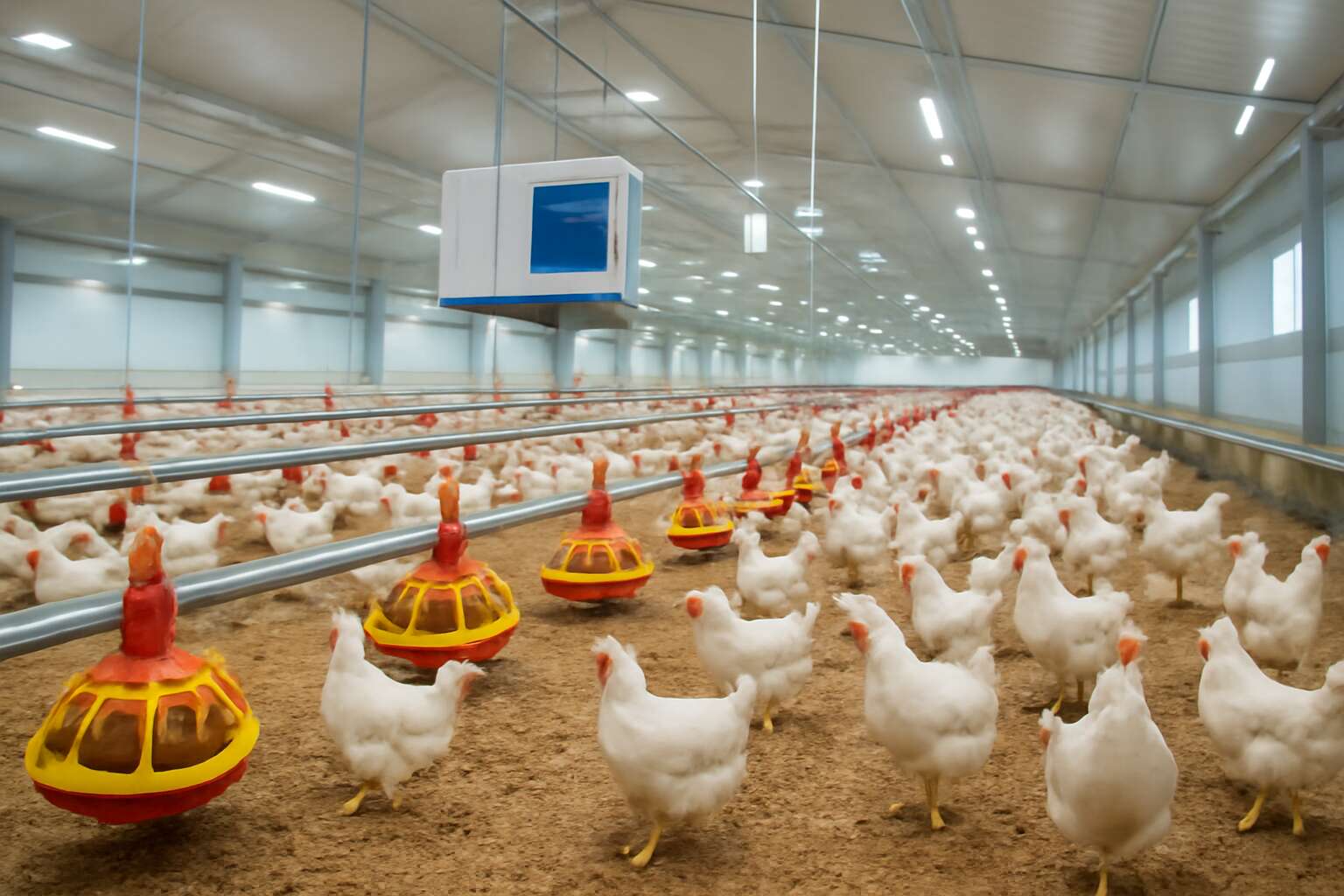
Smart poultry housing and climate control
Automated environmental monitoring and telemetry
Across South Africa’s poultry houses, climate control is currency. Smart poultry housing and climate control turn weather into strategy, shaping uniform growth, welfare, and lower feed-to-gain ratios. When ventilation, heating, and lighting respond to real-time data rather than guesswork, the birds thrive! This is poultry tech in its most practical form, marrying architecture with atmosphere and proving that the right microclimate is a business decision as much as a welfare choice.
Automated environmental monitoring and telemetry extend that logic beyond the walls, translating ambient conditions into actionable insight.
- Real-time temperature, humidity, and ammonia readings
- Remote alerts and automated equipment control to prevent stress
- Historical dashboards for benchmarking and continuous improvement
Together, these systems craft a resilient, scalable model for South African growers.
Ventilation and temperature management
The heartbeat of modern South African poultry houses is climate control—a force turning weather into a production strategy. When ventilation and temperature management respond to real needs rather than guesses, flocks grow more evenly and stress drops. This is poultry tech at work, a fusion of architecture and atmosphere that treats the microclimate as a deliberate business decision. A well-tuned climate is the unsung hero in thriving sheds.
Smart housing choreographs air flow, heaters, and lighting to sustain comfort as birds move through stages. Key levers include:
- Adaptive ventilation that matches flock density and outdoor conditions
- Precision temperature control to minimize drafts and hot spots
- Humidity and air-quality management to protect welfare
These choices create a resilient, scalable model that South African growers can lean on as the sun changes and feed costs shift.
From Cape to the Highveld, climate is an edge—quiet and persistent, like a trusted partner in the shed.
Lighting strategies for productivity and welfare
Smart poultry housing treats lighting as a living partner in the flock’s journey—bright enough to invite appetite, dim enough to invite rest. In South Africa, even a small shift in light can tilt growth curves. In varied climates, lighting strategies shape temperament, feeding rhythms, and the birds’ sense of day and night, all under the banner of poultry tech. A well-calibrated glow turns a shed into a habitat where curiosity and calm coexist, a subtle engine behind steady growth.
- Spectrum tailored to growth stages supports development while avoiding fatigue
- Seamless dawn and dusk transitions minimize stress and abrupt activity shifts
- Uniform, glare-free intensity preserves welfare from nest to feeder
Behind the glow, smart controls align light with climate as a single system. From Cape sunshine to Highveld cool, lighting strategies in poultry tech add depth to performance and welfare, keeping sheds reliable even as seasons change.
Space optimization and stocking density
Smart poultry housing and climate control are the heartbeat of a thriving flock. In South Africa, space is money, and even small layout tweaks can lift performance; producers report up to a 15% bump in feed conversion when the shed breathes with the birds. This is poultry tech in action—systems that sense, respond, and stay reliable as seasons shift.
Space optimization and stocking density are design choices, not afterthoughts.
- Consistent welfare with predictable crowding
- Efficient work zones for feed, drink, and cleaning
- Flexible reconfiguration for different brooder ages or species
With smart housing and responsive climate control, I keep sheds aligned with the flock’s needs and SA’s capricious weather. It’s poultry tech that turns space into steady performance while preserving welfare.
Automation and robotics in poultry farming
Automated feeders and water systems
In South Africa, poultry tech adoption is turning routine into precision farming, with automated feeders and water systems trimming waste. Automation and robotics reduce guesswork, delivering feed in response to real-time data. Sensors monitor flock size and environmental cues to adjust flow and pressure. These systems also cut labor needs and improve consistency across shifts.
- Precise feeding reduces waste and improves feed conversion ratios
- Reliable water delivery ensures constant intake and cleaner drink lines
- Hands-on time shifts to maintenance and welfare monitoring
In South Africa, rugged systems and local service networks keep automation humming, even through load shedding. Automated feeders and water systems can be integrated with telemetry for farm-wide oversight and quick fault detection. This is poultry tech in action.
Robotic cleaning and egg retrieval
Steel beaks of dawn meet the glow of sensors as robotic cleaners glide along the flock’s stage, sweeping litter with whispering precision. In poultry tech, robots scrub and sanitize without disturbing the birds, turning maintenance into a graceful ballet. Egg retrieval follows a choreographed path, the grabber lifting shells with nimble care, sending them to collection without scuff or stress. The system reads real-time cues—humidity, litter depth, and access points—so processes glide in harmony with the birds.
- Robotic cleaning maintains uniform litter and reduces ammonia spikes
- Egg retrieval minimizes breakages and keeps nests pristine
- Integrated telemetry flags faults for immediate action
This is poultry tech in action, weaving reliability with the warmth of human oversight, and giving South Africa’s farmers more time for welfare and growth.
Sorting, packaging, and processing automation
On South Africa’s poultry floors, poultry tech has turned sorting, packaging, and processing into a quiet ballet. Robotic graders weigh, size, and surface-scan every crate, then guide products to collapsible packs with a measured, almost humane efficiency. The flow is not cold; it’s purposeful—an answer to labor gaps that respects birds and people alike.
- Precision sorting reduces mixing and contamination
- Automated packaging speeds throughput and preserves product integrity
- Processing automation delivers consistent labeling, traceability, and waste reduction
This is poultry tech translating science into steadiness, a quiet ethic of efficiency for South Africa’s farmers.
For South Africa, it’s more than speed; it’s stewardship. I sense the shift whenever the clatter fades and accuracy holds.
Farm robotics safety, maintenance, and uptime
On a typical South African hatchery floor, robotic systems tilt the balance toward near-perfect uptime—think 99% during peak weeks. I hear the gears whisper about care for people and birds as automation and robotics in poultry farming shape a quiet discipline that feels almost humane! poultry tech quietly translates science into steadiness.
- Safety protocols guide every robot interaction
- Regular, anticipated maintenance keeps uptime high
- Remote diagnostics and alerts shorten fault times
Safety, maintenance, and uptime become shared responsibilities; technicians and farmers train together, listening for micro-vibrations and tiny faults before they bloom. Regular checks, spare parts, and a culture of rapid response keep the line humming.
This is not cold automation—it’s a philosophy: machines as partners, care as protocol, progress with restraint.
Health management and disease prevention technology
On-farm sensors for health monitoring
South Africa’s poultry farms face a stern truth: a single undetected health shift can echo through a flock before anyone notices. Health management and disease prevention technology acts as a night watchman, turning whispers of illness into clear alarms. In the hush of the barn, on-farm sensors become the pulse that keeps the poultry tech running—silent, unseen, essential.
From roof to floor, sensors track the body’s telltales:
- Microclimate sensors: temperature, humidity, ammonia
- Vision and acoustic monitoring: bird activity, vocalizations, gait changes
- Intake and weight: feed and water consumption, body weight trends
- Health alerts: dashboards, mobile notifications, predictive flags
These components stitch together a narrative of wellness rather than reaction.
I watch the glow of dashboards in quiet corners as dawn creeps in over South African farms, and the data guides prudent decisions without drama! This is health management as poetry with purpose—protecting margins, livelihoods, and the birds themselves.
Disease early warning systems and outbreak detection
Across South Africa’s poultry houses, a single undetected health shift can ripple through a flock in days, devouring margins before anyone notices. Health management and disease prevention technology acts as a night watchman, turning whispers of illness into decisive alarms. This is poultry tech with purpose—observing, predicting, and protecting without drama.
Key capabilities that strengthen disease early warning systems and outbreak detection include:
- Integrated data streams from microclimate and welfare analytics
- Vision and sound cues detect activity dips, vocal changes, and lameness
- Automated outbreak detection compares farm signals with regional data
- Instant mobile dashboards and predictive flags for proactive action
In this quiet arithmetic of alerts, data guides prudent decisions from dawn to dusk, protecting livelihoods and the birds themselves.
Vaccination, vaccination-on-site, and parasite control tech
Fast-moving illness bites the margins before managers blink. In South Africa, a single undetected health shift can ripple through a flock in days, eroding margins and confidence. This is poultry tech at work—turning whispers of illness into decisive alarms!
Vaccination on-site is a core pillar of poultry tech, with automated delivery, reliable cold-chain, and real-time records that flag gaps and renewals. On-farm vaccinators shorten handling stress and accelerate immunity across the flock.
Parasite control tech blends surveillance with targeted, minimally invasive treatments. Digital dashboards alert managers to rising loads, while timed dosing and biosecurity filters keep the flock clean and feed-efficient, reducing losses from worms and external pests. It’s poultry tech in action.
These tools translate data into daily decisions, protecting livelihoods and the birds themselves.
- On-site vaccination reduces transport stress
- Real-time vaccine records improve traceability
- Automated parasite monitoring lowers treatment costs
- Improved feed conversion and flock resilience
Traceability, biosecurity, and vaccination records
Beneath the barn’s shadows, a whisper grows into a warning. In South Africa, a single undetected health shift can ripple through a flock in days. This is poultry tech at work, stitching traceability, biosecurity, and vaccination records into the farm’s quiet heartbeat.
- Traceability from hatchery to pen keeps every life on record
- Smart biosecurity protects entry points and confines the flock
- Vaccination records align boosters with the cold chain
I walk the lit corridors as data hums, turning caution into practice. Each scanned tag tells a life’s tale, and the archive steadies the farm against unseen threats.
I hear the data murmur like a distant organ, guiding my steps through the night-lit aisles until margins hold steady.
Feed efficiency and nutrition technology
Smart feed formulation and ration optimization
In South Africa’s poultry houses, a small shift in feed efficiency can rewrite the ledger. Smart feed formulation is a pillar of poultry tech, balancing energy, protein, and vitamins to meet birds where they are and when they grow!
Ration optimization uses growth models and ingredient data to weather variability—corn prices, soybean quality, and pellet durability. By aligning every bite with the bird’s stage, you unlock savings without sacrificing performance.
- Dynamic amino acid balancing for each growth phase
- Ingredient variability mapping to stabilize feed quality
- Pellet integrity and feed particle size management
The payoff is tangible: improved feed conversion, lower costs, and a more resilient flock—hallmarks that support the bottom line while welfare flourishes.
Feed additives and gut health tech
Poultry tech is a quiet revolution; a single percentage point in feed efficiency can redraw the ledger. In South Africa, where input costs swing like a veld wind, that margin isn’t abstract—it pays the wages of time and feed. Smart nutrition now rests on precise feed additives and gut health tech that align nutrients with the bird’s growth curve.
Feed additives and gut health tech deploy targeted probiotics, enzymes, and buffering to stabilize digestion and immunity as ingredients vary in quality. The aim is a robust gut that converts more feed into muscle and feather, not waste, without resorting to louder interventions.
- Probiotics and prebiotics for microbial balance
- Enzyme blends that unlock bound nutrients
- Organic acids and buffering for steady gut pH
In practice, this is about resilient patterns—predictable performance through fluctuating corn value and soybean quality—embodying the soul of poultry tech with grace and pragmatism.
Precision feeding and growth monitoring
Even a 1% lift in feed efficiency flips the ledger, and precision feeding plus growth monitoring keep pace with the bird’s real-time needs. In South Africa, where feed costs swing like veld winds, poultry tech that reads growth curves is a quiet game-changer.
- Real-time intake tracking paired with adaptive rationing
- Growth-curve aligned nutrition that adjusts by stage
- Early signals for performance shifts without waste
I’ve seen on-farm data turning mere feed into a living system—less waste, more muscle, more feather—delivering predictable performance even as raw materials swing. Precision feeding and growth monitoring stay true to the bird’s rhythm, turning quantity into quality.
Alternative proteins and sustainability metrics
One percentage point in feed efficiency can flip a farm’s balance sheet from red to black, and poultry tech is turning that delta into a daily habit! Real-time nutrition technology tailors energy and amino acids to growth stages, while alternative proteins offer price stability as feed markets swing like veld winds.
- Smart ingredient sourcing lowers waste and slashes protein costs
- Alternative proteins—legume-based meals and insect protein—open new price corridors
- Sustainability metrics such as carbon footprint, water use, and lifecycle impact guide formulations
On South African farms, this blend translates into leaner rations, less waste, and a greener footprint—without sacrificing performance. I’ve seen it translate into real gains on the floor! It’s the quiet revolution of poultry tech, where nutrition science meets sustainability in every batch.
Data analytics, AI, and farm management software
Farm management systems and data integration
Across South Africa, poultry tech has become more than machines; it’s a living ledger where data whispers the path forward. Data analytics, powered by AI, turn millions of data points into signals about health, growth, and resource use. Farms embracing these tools report improvements of up to 15% in feed efficiency.
Farm management software and data integration align operations from hatchery to marketplace, stitching insights into one coherent narrative.
- Unified dashboards for hatchery, nutrition, welfare, and sales
- Real-time data from sensors, feed mills, and records
- Predictive analytics and AI-driven alerts for proactive decisions
With seamless data integration, teams glimpse a holistic picture—disease risk, welfare, and throughput—within a single, illuminated dashboard.
AI-based predictive analytics for production
South Africa’s poultry farms are rewriting their story with poultry tech; numbers become forecasts, forecasts become practice. Data analytics, powered by AI, turn millions of datapoints into signals about health, growth, and resource use. Farms embracing these tools report improvements of up to 15% in feed efficiency.
Within a robust farm management software backbone, AI-based predictive analytics for production forecast batch timing, optimize inputs, and flag early anomalies—before they disrupt operations. The aim is proactive decisions that balance welfare with throughput, reducing waste and lifting margins.
- Forecasting production windows
- Prescriptive maintenance alerts
- Dynamic resource allocation
Such tech, when woven with data-driven discipline, becomes a steady compass for farmers under South Africa’s sun.
IoT networks, data security, and privacy
Across South Africa’s poultry sheds, data streams from sensors, cameras, and automated feeders stitch a living map of health and appetite. Data analytics, powered by AI, convert millions of datapoints into actionable signals that guide nutrition, welfare, and throughput. In this landscape, poultry tech is a backbone, where farm management software unifies IoT networks into one responsive heartbeat!
Data security and privacy are non-negotiable. Encryption in transit and at rest, strict access controls, and multi-factor authentication shield sensitive strategies and health records. Compliance with POPIA ensures governance, transparent retention, and auditable trails—preserving trust across suppliers, farmers, and processors.
- Real-time dashboards
- Secure data sharing
- Role-based access control
Together, these layers empower resilient ecosystems across South Africa.
KPIs, benchmarking, and performance dashboards
Across South Africa’s poultry sheds, data-driven poultry tech is rewriting the rules. Last year, farms using real-time analytics cut feed costs by up to 12%. Data analytics and AI translate millions of datapoints into signals that optimize nutrition, welfare, and throughput. This is the promise of poultry tech in South Africa.
- Feed conversion ratio (FCR)
- Mortality rate per flock
- Average daily gain and production uptime
KPIs become benchmarks when fed into performance dashboards spanning sheds and regions. Farm management software links analytics to action, surfacing alerts on FCR drift, weight changes, and welfare signals. Real-time dashboards, secure data sharing, and role-based access keep teams aligned and responses swift.
This edge is built on visibility, trust, and rapid improvement.
Compliance, traceability, and reporting tools
One rock-solid data trail can prevent a recall worth millions. Across South Africa’s poultry operations, data analytics, AI, and farm management software turn compliance from a chore into a feature that guides decisions in real time.
Compliance, traceability, and reporting tools translate countless datapoints into auditable records regulators and auditors actually trust. A concise governance layer with role-based access keeps who saw what, when, and why crystal clear!
- Audit trails that document every action
- Traceability logs from flock to floor
- Automated regulatory reports tailored to SA standards
This is poultry tech that protects margins while elevating welfare and transparency.




0 Comments