Ventilation Requirements for Poultry Facilities
The Role of Fresh Air in Flock Well-Being
A South African summer can push temperatures in a poultry house past 35°C within minutes. Fresh air is not a luxury, it is the difference between a thriving flock and a stressed one. Ventilation controls humidity, removes ammonia, and regulates temperature. Without proper airflow, birds huddle, pant, and eat less.
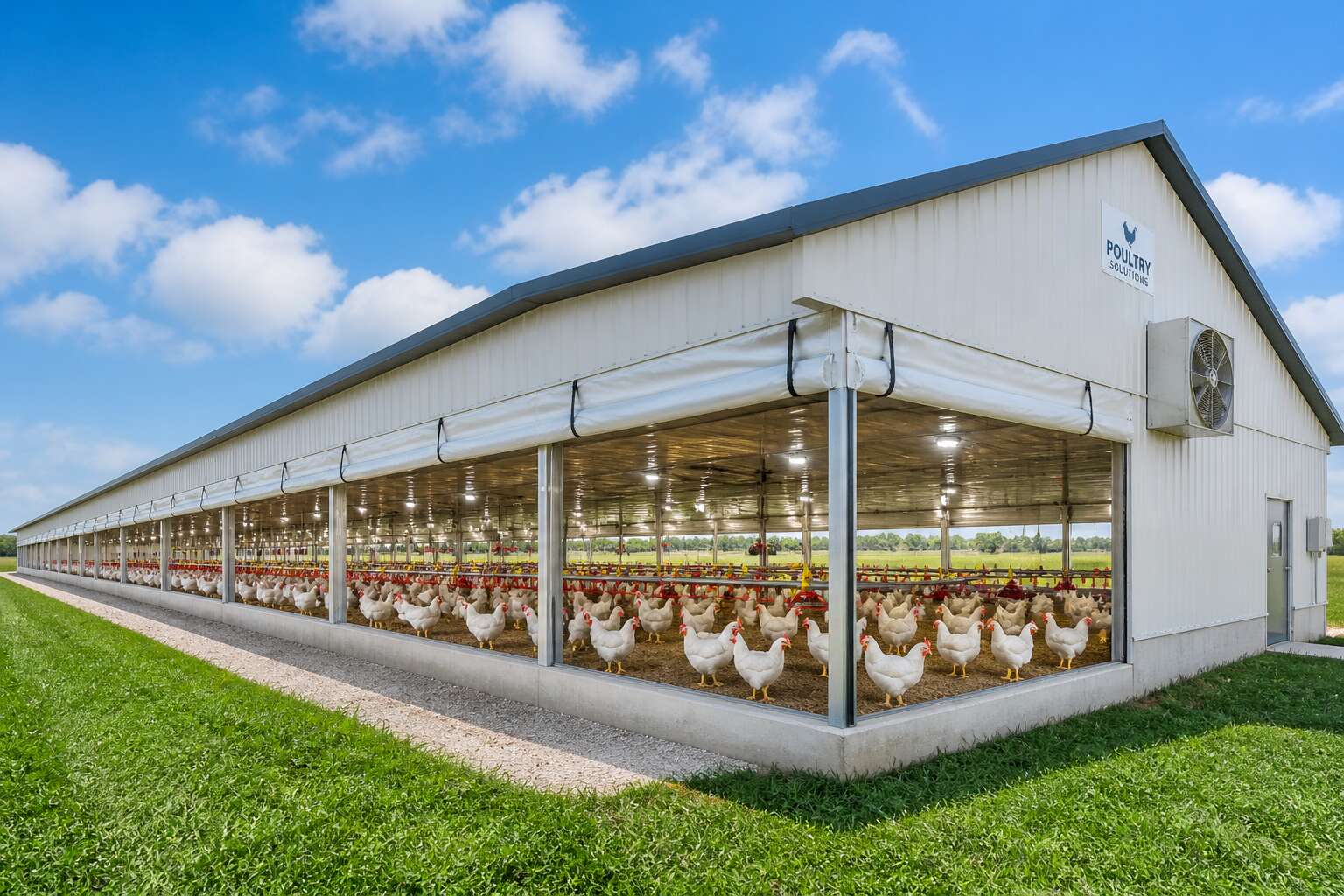
This is where poultry curtains play a direct role. They allow managers to adjust air intake based on wind speed and flock age. A curtained house can respond to sudden weather shifts, pulling in cool morning air and shutting out midday heat. Poultry curtains also help maintain consistent air pressure across the house, preventing dead zones. Good ventilation keeps litter dry, which reduces footpad lesions and respiratory challenges. When air moves correctly, birds spread out evenly and consume feed at a steady rate.
Managing Heat and Humidity in Grow-Out Houses
Relative humidity above 80% in a grow-out house damages birds faster than temperature alone. It amplifies heat stress and turns litter into a wet, ammonia-soaked hazard. South African summers make this a constant threat.
Poultry curtains are the most practical solution. They give managers precise control over air intake, and that control shapes how air moves across the house. Without properly fitted poultry curtains, air rushes through gaps and creates dead zones where humidity collects.
The practical targets are straightforward:
- Relative humidity between 50% and 70%
- Ammonia below 20 ppm
- Air movement of 0.5 to 2 meters per second at floor level
- Static pressure matched to curtain opening and fan capacity
When these figures hold, birds eat steadily, litter stays dry, and the house feels cooler than the outside air. In my experience, the houses that hit these numbers consistently have calmer birds and steadier weight gain.
Preventing Toxic Gas Build-Up
Ammonia and carbon dioxide accumulate silently inside a grow-out house. Respiratory damage begins before the smell becomes obvious. Ventilation requirements for poultry facilities must prioritize toxic gas prevention as rigorously as temperature management. Properly fitted poultry curtains generate negative pressure that forces stale air out and draws fresh air through planned openings.
Gas concentrations shift with bird age and litter moisture. Ammonia above 20 ppm weakens the respiratory lining. Carbon dioxide above 3000 ppm signals poor air exchange. Carbon monoxide from heaters adds another danger. These gases respond to controlled inlet direction.
Well-fitted curtains balance static pressure and opening size. When curtains seal correctly, incoming air mixes with warm ceiling air before reaching floor level. That vertical mixing prevents dense gas pockets near the birds. poultry curtains keep gas readings low even at moderate fan speeds.
Choosing the Right Curtain System for Your Barn
Manual versus Automated Curtain Operation
Sixty two percent of South African growers still raise and lower their poultry curtains by hand, a practice that ties flock health to human vigilance. Manual systems offer low initial cost and simple repair, but they demand hourly attention during temperature swings. Automated curtain operation, meanwhile, responds to thermostat or timer inputs, freeing workers for other duties.
The choice hinges on your barn size and labour budget. Consider these factors:
- Power reliability in your region
- Number of curtain drops per day
- Backup options during load shedding
I have seen well managed manual curtains outperform neglected automation. Yet for large houses, automated poultry curtains reduce the risk of sudden heat stress. The right system is the one your team can actually maintain.
Selecting Durable and Energy-Efficient Fabrics
South Africa’s sun ruins standard poultry curtains within two seasons. UV-stabilised polyethylene with a denier above 1000 holds up. Budget materials turn brittle and tear at the grommets, silently, long before you spot the heat stress.
I look at the whole system: the curtain track, the winch geometry, and the seam integrity. A rack and pinion system distributes force evenly. Manual winches with crossed cables always bind!
- Fabric mass of 200g/m² or more for insulation
- Double-stitched hems with woven polypropylene edge tape
- Grommet spacing under 30cm to prevent tearing
Reflective fabric can cut radiant heat transfer by a third. Your poultry curtains must survive hail, wind, and 14 hours of direct UV in midsummer. The west wall of a grow-out house faces the afternoon sun directly. That is where every seam is tested.
Curtain Hardware and Mounting Essentials
A roof-mounted winch, positioned for convenience, is a hidden gremlin. Unless the cable runs perfectly vertical to the curtain, it will chafe and eventually snap. This mechanical failure is more common than fabric failure in South African grow-out houses, yet most producers inspect the cloth religiously while ignoring the hardware. For poultry curtains, the mounting system determines longevity more than the material itself.
The alignment of every pulley and bracket must be checked before installation. A rack and pinion system, when properly mounted, distributes force evenly across the entire curtain face. Manual winches with crossed cables will always bind. The vertical drop must be guided by a steel track, not simple eye bolts, to prevent the fabric from buckling in the wind.
I look at the whole system as a single unit. The track profile, the wall brackets, and the corner pulleys all work together. A cheap plastic pulley with a metal axle will seize within months. Use sealed bearings for every moving part.
– Anchor brackets must be bolted into concrete or steel, not wooden purlins.
– Use galvanised steel cable with a minimum 4mm diameter.
– Install a limit switch on automated systems to prevent over-winding.
– Clearance between the track and the curtain edge should be 10mm to allow for thermal expansion.
A curtain track mounted slightly out of level creates uneven tension. The lower edge will ripple, allowing draughts at the floor line where chicks rest. This subtle misalignment is a quiet killer of performance. Take a spirit level to every bracket. The west wall of a grow-out house faces the afternoon sun directly, and the heat expansion of the steel track will exaggerate any mounting error. A horizontal track is a promise of even operation for years.
Side-Wall Curtains and Ceiling Inlets
An ill-matched inlet and curtain system can waste 30% of your ventilation capacity. Side-wall poultry curtains move large volumes of air at low speed, while ceiling inlets create a directed jet along the roof. The trick is choosing a system where the two complement each other, not compete. I have walked through houses where the curtain opens but the inlet angle forces air straight down onto the litter.
- Verify the inlet throat width matches your curtain lift height.
- Position ceiling inlets to avoid direct drafts on day-old chicks.
- Select a curtain track profile that tolerates dust from the inlet air.
For South African grow-out houses, run side-wall poultry curtains as the main exhaust path and ceiling inlets as the controlled intake. That pairing balances pressure, keeps ammonia levels down, and simplifies your climate controller. Get the selection right once, and the whole house maintains even conditions!
Compatibility with Existing Climate Control
A climate controller is only as precise as the curtain system it commands. If the actuator speed and the controller’s sensor sampling don’t align, the house will swing between stale air and direct drafts. I see this mismatch in retrofitted South African barns more often than builders admit.
Compatibility starts with signal voltage and limit switch feedback. The controller expects a specific response time from the poultry curtains. When the curtain motor lags behind the ventilation stage, pressure drops and the controller overcorrects, wasting energy and stressing the flock.
- Confirm actuator travel time matches the controller’s minimum run time.
- Check that limit switch positions align with the controller’s open and close thresholds.
- Verify the curtain track friction does not exceed the motor’s rated duty cycle.
Then there is the protocol itself. A controller that modulates curtains in discrete steps behaves differently from one using proportional control. Match the poultry curtains’ mechanical resolution to the controller’s output resolution. This is where retrofits usually fail!
Designing an Effective Curtain Ventilation Layout
Sizing Curtain Openings Based on Stock Density
The gap between poultry curtains and the sidewall determines how much fresh air each bird receives. In a grow-out house holding 30 000 broilers, a small error in opening height can shift airflow by several cubic meters per minute. South African producers often face both hot afternoons and chilly evenings, so the layout must respond to daily temperature swings.
Sizing starts with stock density. A house with 18 birds per square meter produces more metabolic heat than one with 12, and the curtain must rise higher to vent that load. Calculate the total live weight, then divide by the effective wall opening to find the correct lift distance.
- Weekly measurements of average bird mass.
- A simple multiplication of bird count to obtain house weight.
- Comparison of that figure against fan capacity.
Poultry curtains function best when these numbers guide each adjustment. Regular checks of the actual opening against the calculated value prevent both suffocation and chilling.
Positioning Curtains for Optimal Cross-Flow
Air moves in the path the house permits, not the path you intend. In Highveld houses, that path is set before the fans switch on. Position the poultry curtains on the windward wall and the fans opposite to create true cross-flow. This pushes fresh air across the litter and out through the fan bank.
For cross-flow positioning, I rely on three decisions:
- Windward wall orientation.
- Curtain drop height.
- Fan position relative to the curtain line.
The gap between the curtain edge and the sidewall matters less than the direction of airflow. Poultry curtains that open on opposite walls create a pressure difference that drives ventilation. A house with one-sided openings draws air down the center, not across the birds! An inward fold directs air down for winter; an outward opening directs air along the ceiling for summer cooling.
Pairing Curtains with Exhaust Fans and Pads
Effective curtain ventilation layout requires more than opening a flap. In South African grow-out houses, the relationship between poultry curtains and mechanical exhaust dictates air quality. Fans create negative pressure, but only when curtains admit air evenly. Pads cool incoming air, yet they demand a sealed curtain line to avoid bypass.
- Align curtain openings with fan cone velocity zones.
- Position pads on the same wall as curtain lifts.
- Seal curtain edges to prevent dead spots.
Pairing poultry curtains with exhaust fans and pads transforms ventilation from guesswork into a controlled system. The curtain becomes the intake valve, the fan the driver, and the pad the conditioner. When they work in sequence, air moves uniformly across the flock. No single component compensates for a mismatched layout.
Ensuring a Tight Seal in Cold Weather
In South Africa, a cold front can drop a grow-out house temperature by eight degrees in under an hour. That makes the seal on your poultry curtains as important as the fabric itself. A curtain ventilation layout that works in summer heat will fail in winter if air slips through the gaps.
Check the bottom edge first. If the curtain does not sit flush against the wall, cold air pools at bird level. Use a weighted hem or a batten to hold the fabric down. The curtain line must stay straight across the full length of the wall.
- Close the curtain fully and secure the bottom edge before sunset.
- Overlap the curtains at the centre by at least ten centimetres.
- Inspect rope guides for slack that lifts the fabric off the wall.
Poultry curtains with a proper seal reduce fuel costs and keep litter dry. A tight layout in cold weather forms the baseline for healthy birds.
Curtain System Maintenance and Common Failures
Routine Checks for Wear and Tear
A curtain that works today can fail tomorrow without warning. Ultraviolet rays and red dust attack the fabric and hardware daily. I tell growers to inspect their poultry curtains every week, not every month. Look for frayed edges along the bottom hem, where the cloth rubs against the wall and concrete. Check the stitching around every grommet and strap anchor.
Most failures start small.
– Corroded pulleys that catch and jerk the cable
– Slack in the drive line that lets fabric flap on windy days
– Stretched material that no longer pulls tight against the frame
Catching these early keeps the system working through the hottest afternoons and the coldest nights.
Troubleshooting Winch and Cable Issues
A winch that spins freely is not a time saver. It is a fire drill waiting to happen. On South African farms, where the Highveld sun bakes cables and the wind whips them, winch systems on poultry curtains fail in predictable ways. The worm gear strips, the cable birdcages, or the drum lock slips. Each failure announces itself differently. When the handle turns but the curtain stays put, the keyway has sheared. When the cable bunches unevenly, the drum is fighting itself. Check these signs:
– A winch handle that turns with no resistance
– Cable that rides over previous wraps
– A ratchet that clicks but does not hold
Tightening with the brake engaged creates false tension. Release the brake, let the curtain settle, then rewind. Corrosion on the cable strands is a quiet killer. Replace, do not patch.
Repairing or Replacing Curtain Panels
A torn panel never announces itself. It simply lets the wind in and the heat out. Over time, the fabric along the hem frays where fasteners bite, and small holes become gashes. I once saw poultry curtains fail on a Highveld farm, and the flock was panting by midday.
Repairing a panel depends on the failure. The reinforcement strip above the eyelets often wears through, and then the panel pulls apart under load. A clean cut near the hem can be stitched with polyester thread. A jagged hole in the middle means the material has lost tensile strength.
- Replace panels with visible light shining through the weave
- Repair only if the tear is shorter than 150 millimetres
The old poultry curtains tell you everything. Their grommet spacing matches your cable hooks, and a mismatched replacement will twist as it lifts, stressing the winch.
Financial Factors for Curtain Upgrades
Installation Costs and Budgeting
Installing new poultry curtains presents a financial decision that weighs on every South African producer. Recent industry data suggests that curtain upgrades account for up to 7% of annual maintenance budgets. Installation costs vary sharply based on house dimensions and automation levels. A manual system for a 30 metre house might cost R15,000, whereas a motorised setup with sensors can exceed R45,000.
- Labour rates per square metre of curtain wall
- Cement and steel for mounting posts
- Conduit and cabling for electric actuators
Budgeting for these poultry curtains demands a clear eyed look at hidden expenses. Foundation work often surprises owners when soil conditions require extra depth. Weather delays can double the labour bill. Producers who allocate a 10% contingency fund navigate the process with far less strain. The long term payoff appears in lower heating and cooling costs, yet only if the initial budget holds firm.
Energy Savings and Operational Benefits
Electricity tariffs in South Africa have climbed by double digits for years. Poultry curtains directly influence that cost. A curtain that seals properly cuts the load on heaters in winter and on fans in summer.
That translates into measurable savings. Producers who upgrade to insulated or reflective fabrics report lower monthly utility bills. The operational benefits extend beyond power consumption. A motorised system frees workers from raising and lowering panels by hand.
- Reduced fan runtime during peak tariff hours
- Better feed conversion from stable temperatures
- Lower maintenance frequency on heating equipment
Taken together, these benefits justify the upgrade cost.
Long-Term Durability and Warranty
The upfront cost of poultry curtains can make a producer pause. But the financial picture changes when you measure durability across a decade of South African summers and winters. A quality curtain fabric should resist UV degradation and maintain its seal after years of winch-driven movement. Warranties vary widely, so compare the fine print. Some manufacturers cover fabric only, while others include tracks, seals, and labour.
Consider these financial factors when budgeting:
- The expected lifespan of the fabric versus the cost per year of use
- Whether the warranty covers UV fading, stitching failure, and edge curl
- The reputation of the local supplier for honouring claims without delay
A five year warranty on a panel that lasts eight years is more valuable than a ten year warranty on fabric that fails at four. Poultry curtains are a long term investment, and the numbers only add up when durability and warranty protection align with your actual climate and daily operation.
Government Grants and Agricultural Loans
A hefty capital outlay can stall even the most progressive farming enterprise. Yet the funds for these essentials often lie dormant in state and agricultural channels. South African producers may access dedicated streams for infrastructural improvements, and this is where the vision for modernised poultry curtains meets practical reality.
– The Land Reform and Agricultural Development programmes offer targeted financial support
– Provincial agricultural departments often roll out annual funding cycles for climate control systems
– Agribusiness banks provide tailored loan products with grace periods aligned to production seasons
Each funding avenue carries specific application windows and compliance obligations. The true skill lies in matching your upgrade timeline to the right financial instrument. Grants may not cover the full installation, but they can offset a significant portion of the initial quote. Loans, meanwhile, transform a cumbersome lump sum into predictable monthly payments. Local agricultural economists suggest reviewing these options during your annual planning cycle. When the numbers align, the path from old, brittle fabric to taut, responsive panels becomes a matter of paperwork, not just capital.


0 Comments