Understanding Poultry Rings and Their Primary Uses
What Are Poultry Rings and Why Do Flock Owners Use Them?
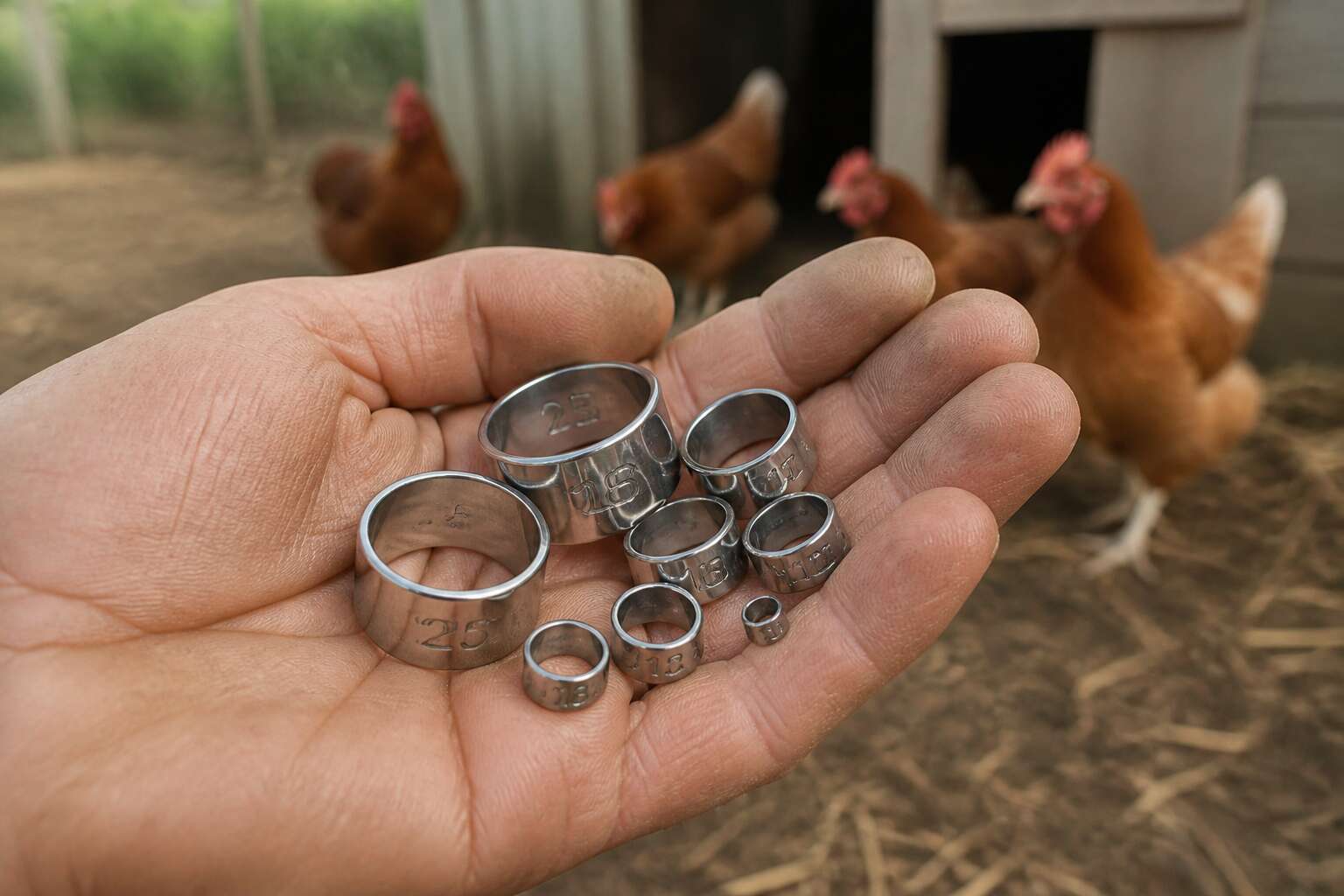
In South Africa, a single unmarked bird can vanish into a mixed flock within minutes, yet the solution costs less than a loaf of bread. Poultry rings are lightweight bands, often made of aluminium or plastic, that fit around a bird’s leg. They carry unique numbers or colours for instant recognition.
Flock owners use these rings for several reasons:
- Tracking breeding lines and parentage
- Recording age and vaccination schedules
- Preventing theft disputes with visible ownership marks
When you search for poultry rings for sale, you are investing in order. A ringed hen is immediately identifiable among the flock, allowing you to spot illness early or confirm egg production patterns. It is a small tool with a large role in daily flock management.
The Role of Leg Bands in Poultry Identification
Leg bands answer a question that surfaces daily in any serious flock: which bird is this? The leg offers a vantage point without hindering movement or feathering. Aluminium split rings require pliers to close, whereas spiral plastic bands twist on in seconds. Both leave a legible mark that endures across seasons.
Colour coding is where leg bands reveal their utility. In my experience, assigning one colour per year allows a quick scan of the run to disclose each bird’s age instantly.
- Red rings indicate the current laying season
- Blue rings identify pullets approaching maturity
- Green rings mark breeders kept apart from the main flock
Among poultry rings for sale, the numbering deserves as much scrutiny as the material. A numbered band links to a ledger entry, documenting each bird’s movements between pens without a single capture. Quality poultry rings for sale retain their digits through mud, sun, and annual moults.
Comparing Plastic, Metal, and Adjustable Ring Options
Poultry rings for sale generally fall into three material camps, each suited to a different job. Plastic rings weigh almost nothing, which matters for light breeds like Leghorns. Metal rings, usually aluminium or steel, outlast plastic but demand a firm fit from day one. Adjustable rings use a sliding or locking closure to grow with a young bird.
South African heat can make cheap plastic rings brittle by midsummer. Metal handles sun and dust without losing legibility, though applying it takes two hands and a pair of pliers. Adjustable options cost more per unit but save time when rearing mixed ages.
Consider how often you handle each bird:
- Plastic: ideal for single-season colour tags
- Metal: best for permanent numbered records
- Adjustable: practical for juveniles or changing flocks
How Poultry Rings Support Flock Record Keeping
Most flock owners will eventually face the same quiet problem. You look at a row of hens and realise you cannot remember which bird laid which egg, which one is sluggish, or which one produced that record weight last month. The visual chatter of a full coop becomes useless without a clear system. This is where the humble leg ring steps in as a quiet but essential tool for flock management.
Poultry rings for sale in South Africa are often purchased for simple identification, but their primary use extends into the daily rhythm of record keeping. The ring acts as a physical anchor for data. With a numbered band, you can maintain a log that tracks each bird’s egg production, weight changes, and health observations without relying on memory. It turns your poultry house into a data point, not a guessing game.
The real value appears when you have multiple generations or mixed breeds. A quick glance at a leg gives you instant access to a bird’s history. Consider what a numbered ring allows you to do:
- Track individual egg output against commercial benchmarks
- Isolate a specific hen for treatment without catching every bird
- Identify breeders with proven genetic performance
- Monitor growth rates for birds destined for market
These records become the foundation for culling decisions, feeding adjustments, and breeding priorities. A metal ring with a permanent number is the most reliable, as it resists the constant rubbing of dust and sun. When you purchase poultry rings for sale, you are not just buying a piece of plastic or aluminium. You are buying a management tool that makes every interaction with your flock more deliberate and less chaotic.
Essential Factors to Consider Before Buying Poultry Rings
Selecting the Right Material for Outdoor Durability
The brutal Highveld sun does not negotiate. When you scan poultry rings for sale, the material’s response to ultraviolet radiation often matters more than the price tag. Plastic rings may fade or become brittle within a single season. Metal variants offer strength but risk rust if galvanisation is thin. Before committing, consider these outdoor durability factors:
- UV stabilisers in nylon or polycarbonate
- Gauge thickness for impact resistance
- Corrosion resistance under wet conditions
Stainless steel handles coastal humidity, yet aluminium rings stay lighter for smaller breeds. The choice hinges on your specific climate and the birds’ behaviour. A ring that works in the Karoo might fail in Durban’s salt air. Think about what your birds will actually endure.
Determining Correct Sizing for Chickens, Turkeys, and Ducks
Imagine a flock where every bird carries its own small story, etched not in ink but in the precise circle of a leg band. The first rule of poultry identification is that size is a silent language. A ring too tight becomes a tourniquet, a ring too loose is a lost sentence. When you browse poultry rings for sale, you are not just buying a product, you are fitting a narrative to a bird’s leg. The correct measurement matters more than the colour or the engraving.
The anatomy of a bird’s foot is not static. It is a structure of sinew and scale that settles and grows. For chickens, you need a ring that sits above the spur, but below the joint. A young pullet might wear a size that becomes obsolete in a year.
1. Chickens, bantams and standard breeds, require a diameter between 12mm and 16mm.
2. Turkeys, with their thicker tarsi, demand a larger span, often 19mm or more.
3. Ducks, whose legs taper differently, need a closed ring that is narrow yet high, to clear the webbing.
The pressure point is always the heel. A ring that slides past the toe with a whisper is correct. One that requires force is a mistake. The best advice is to measure the thickest part of the shank, then add a millimetre of air. The Highveld heat causes swelling, and a tight ring on a hot afternoon is a cruelty. Buy from suppliers that offer size charts, and trust the numbers over the eye. The leg will tell you the truth, if you listen.
Understanding Numbering Systems, Colors, and Coding Schemes
Numbers and colours are not decoration. They form a code that turns a pile of poultry rings for sale into a management tool. Different suppliers use different numbering scales, so a size 12 from one brand may not match another. Always confirm the manufacturer’s chart before ordering.
Colour coding offers a fast visual shortcut. Many South African breeders assign a colour per hatch year or bloodline. A glance at the flock reveals age groups without handling every bird. Some use the universal leg ring colour chart, where each year has an official hue.
- Match the numbering system to your record keeping method.
- Verify colour codes against the breeder’s standard.
- Choose coding that remains readable after mud and sun exposure.
Engraving adds another layer. Letters and digits carry identity, but only if the font stays legible. The system you adopt should survive the Highveld conditions, because a faded band is useless.
Evaluating Ring Closure and Safety for Bird Legs
Every clip and clasp carries a consequence. A bird can lose a toe or its footing from a poorly sealed band. Poultry rings for sale in South Africa should lock cleanly without pinching, but cheap imports fail this test before the first winter.
Inspect edges. Moulded plastic leaves burrs; metal shears. Run a fingernail along the inner surface. If it catches, the ring catches skin and tendon. Check for a positive click, one that holds under fence wire, yet opens with deliberate pressure.
- Choose bands with rounded inner edges, never sharp.
- Test the gap closure three times before fitting a bird.
- Reject any ring that requires tools to remove.
That last point matters. After a season of Highveld dust, a ring that should twist free can fuse shut. Verify the vendor offers a sizing match; tight rings cut circulation, loose ones invite snagging.
Checking Compliance With Local Poultry Registration Laws
South Africa’s Veterinary Procedural Notice for poultry disease control makes traceability a legal matter, not a choice. When you search for poultry rings for sale, you are purchasing a traceability record. The ring must match the registration numbers accepted by your local animal health authority, and those numbers differ by province. A band that suits a Free State flock may not satisfy a Western Cape inspector.
Verify three things before purchase:
- Whether your municipality requires leg bands for shows or sales
- Whether the numbering system aligns with your provincial veterinary database
- Whether the ring size corresponds to the species you register
The vendor’s catalogue may list poultry rings for sale, but compliance demands proof that the numbering sequence is traceable. Ask for the registration authority’s stamp or a certificate of conformity. Without that, your records stand on guesswork.
Where to Find Poultry Rings and What to Expect From Retailers
Exploring Online Marketplaces and Specialty Poultry Stores
A local feed store in the Free State once told me that half his poultry ring sales were for exhibition birds, not egg layers. That distinction matters when you shop. The most reliable sources for poultry rings for sale are agricultural co-ops and specialty poultry outlets, which understand the difference between a temporary plastic band and a permanent identification tool.
Online marketplaces offer convenience, but verify the seller’s reputation before committing. Look for clear photos of the ring’s closure mechanism and read comments from other flock owners. In contrast, a physical store lets you inspect the material flexibility and test the fit on your bird’s leg immediately.
Specialty stores often stock both imported and locally manufactured rings. Their staff can recommend a size based on your specific breed, which is valuable when you raise odd-sized fowl. You will also find that these retailers frequently offer bulk pricing for numbered sequences. Buying directly from a co-op can yield bundled poultry rings for sale at a lower per-unit cost, especially if you need to band a new hatch. The key is to purchase from a source that prioritises bird safety over volume.
Sourcing From Local Agricultural Supply and Feed Shops
In the Free State, a farmer once told me that his local feed shop understood the difference between a cheap band and a durable ring. That insight holds true across South Africa. When you walk into an agricultural supply store, you are tapping into decades of practical knowledge. Staff often band their own flocks, so they can show you how a ring sits on a leg and which closure survives harsh sun.
Local shops keep poultry rings for sale in modest quantities, which means you can inspect the flexibility and fit before committing. You may also find bulk pricing for numbered sequences, particularly when new hatch season approaches. Here is what to expect:
– Honest sizing advice based on your specific breed
– A mix of imported and local manufacturers
– Clear guidance on closure mechanics and leg safety
When you source directly from a feed shop, the recommendations you receive are grounded in field experience, not catalogue promises. That practical wisdom often leads to better outcomes for your birds.
Weighing Bulk Purchases vs. Small Individual Pack Quantities
Beyond the aisles of agricultural co-ops, the trade in poultry rings for sale carries a quieter rhythm. Specialty breeders sell directly from their farms, offering rings that have survived dust and downpour. Their stock is lean, but quality speaks in the weight of each closure.
Bulk purchases promise economy, yet they ask for patience. A box of five hundred numbered rings is a commitment, not a convenience. Individual packs cost more per ring, but they let you test a material’s behaviour before binding yourself to a thousand identical loops.
- Bulk orders suit established breeders
- Small packs serve newcomers and mixed flocks
- Discounted sequences exist for bulk poultry rings for sale
Every retailer carries their own temperament. Some hoard old stock; others rotate fresh batches with the seasons. The ring’s edge under light reveals everything. A sharp seam will wound a leg faster than any predator.
Reading Customer Reviews to Gauge Ring Quality and Fit
A single review of poultry rings for sale often reveals more than a product photo. When a breeder in Mpumalanga notes that a ring slipped off after three months of rain, you understand fit better than any size chart can explain.
Retailers differ in their return policies. Some test rings on live birds before dispatch; others quietly clear old stock. Look for reviewers who mention the closure method. A complaint about a brittle seam deserves attention.
- Check reviews for comments on leg diameter and growth
- Ask about batch freshness from the seller
Omissions matter. A review praising a ring’s colour but saying nothing about durability leaves a subtle warning.
Reviewing Return Policies and Replacement Guarantees
Not all suppliers of poultry rings for sale operate with equal diligence. Physical farm supply stores often allow you to handle the merchandise, bending a sample ring between your fingers to test its spring. You can feel the difference between virgin nylon and recycled plastic that has gone brittle. Online sellers, meanwhile, rely on product photography that flatters. Their stock may sit on a shelf for years before reaching your coop.
The return policy reveals more about the retailer than their advertising copy. A seller confident in their poultry rings for sale will offer a straightforward replacement for defective items. Here is what to examine before you pay:
1. Whether the guarantee covers split rings after application
2. If the seller accepts returns on unopened bulk packages
3. How the replacement process handles shipping costs
Some distributors offer a 12 month warranty against manufacturing faults, while others simply block dissatisfied customers. Ask about batch age. Fresh stock matters because polyurethane degrades slowly over time, weakening long before you notice any visual change. The best suppliers track their inventory and refuse to sell faded, shelf worn product. Their rings arrive in sealed bags with clear manufacturing dates. A retailer who cannot answer this simple question deserves your suspicion. Rings that snap during application usually indicate old material, not a bird with an unusually strong leg.
Considering Shipping Timelines and Availability
The freshest stock moves first, and a seller’s shipping schedule tells you how close they are to the source. A farm supply shop in Mpumalanga with a high turnover of poultry rings for sale will likely ship within 48 hours. A drop shipper in Johannesburg, however, might quote a five day delay while their supplier restocks. That lag signals your rings could be from an older batch.
Check the courier options before you commit. The cheapest route across the country can take a week or more, which matters when you are banding day old chicks. Pay attention to the order cut off time. Some retailers dispatch before 12:00, others only on Mondays and Thursdays. A two day gap between payment and pick up is common for specialist dealers.
Here is what to ask a retailer about their logistics before you buy:
1. Do they keep physical stock on hand, or do they order each batch from a factory?
2. What is their stated dispatch window for standard and express shipping?
3. Can they ship via a specific courier, such as The Courier Guy or PostNet, to your area?
4. Do they consolidate orders if you need multiple sizes of poultry rings for sale?
Rural addresses in the Karoo or Limpopo often fall outside standard overnight zones. A retailer who is transparent about these timelines saves you from a failed hatch and a frantic Friday afternoon. Online marketplaces like Bidorbuy show estimated delivery dates, but those are often optimistic. Independent sellers who specialise in aviculture equipment tend to give more accurate dates because they handle the packaging themselves.
Stock availability also shifts with the season. Poultry rings for sale become scarce after August when farmers register their breeding stock. Expect longer wait times during that window. A supplier with a live inventory counter on their website is a good sign. If the page simply says “in stock” without a quantity, prepare for a potential backorder. The most reliable dealers will tell you exactly how many packs they have left and when the next manufacturing run arrives.
How to Apply, Maintain, and Replace Poultry Rings Safely
Step-by-Step Instructions for Proper Leg Band Fitting
A loose leg band is a silent threat. I have seen swollen toes and permanent lameness from rings fitted without care. To begin, cup the bird’s hock joint firmly. Slide the band over the three front toes, then coax it upward past the spur site.
- Dip the ring in warm soapy water for lubrication.
- Position the closure seam outward to prevent skin pinching.
- Twist the band gently until it sits above the foot pad.
- Check that one finger slips between ring and leg.
Maintenance demands weekly inspection. Dirt and manure build up under plastic bands, creating abrasive conditions. Replace any ring that shows cracks, fading, or a change in fit. When swapping, use a cutting tool designed for plastic, never a knife. For metal bands, crimp the open ends with pliers but verify they rotate freely. Always keep spare poultry rings for sale in your storage bin, because a swollen leg needs immediate attention.
Recognizing Signs of Overly Tight or Loose Rings
When applying poultry rings for sale, face the closure seam outward and test clearance with one finger. A ring that slides on without resistance will migrate. Any drag against the hock signals a problem. Weekly inspections reveal these warning signs:
- Skin swelling above or below the ring
- Visible abrasion or feather loss at the contact point
- A ring that rotates too freely or not at all
Replace cracked or faded plastic with a plastic cutting tool. Metal bands require pliers crimping but must still spin. Spare rings in storage prevent delays when sudden swelling occurs.
Adjusting Ring Sizes as Birds Grow and Mature
The application of a leg ring is a quiet task. I prefer to work in the grey hours of morning, when the flock is calm and the light is honest. Slide the ring over the foot with a gentle rotation. Never force it past the hock. A bird’s leg swells and thins with season and age.
Weekly inspection is the keeper’s burden. The ring must spin freely yet resist sliding over the hock joint. When searching for poultry rings for sale, choose adjustable widths for growing birds. Plastic rings decay under the African sun. Replace cracked bands before they create pressure sores. Metal rings require pliers for crimping, but they must still turn.
- Measure the tarsus at its widest point every month
- Replace any ring that leaves an imprint on the skin
As birds mature, the leg thickens without warning. Adjust the ring before it embeds itself in the flesh! For young birds, choose room over precision. A lost ring is a minor sorrow. A damaged leg is not.
Best Practices for Safely Removing Old or Damaged Rings
Rings outlive their welcome. That is a truth every keeper discovers in time. The plastic that seemed supple at application becomes brittle. The metal crimp that felt secure now digs into the hock with a pressure that demands action. Applying a ring is a promise of identity. Removing one is an act of surgical patience. The risk of tearing the delicate scales of the tarsus is real. The risk of leaving a ring that has begun to restrict circulation is worse. I assess the ring’s condition each time I handle a bird. I look for hairline fractures, for discoloration, for any puckering of the skin around the edges.
When the moment comes, I recommend cutting rather than pulling. Pulling a ring over the foot of a mature bird is an exercise in torment for both parties. Use a small pair of cutters designed for plastic or soft metal. Position the jaws against the ring, not the leg. Apply steady pressure. The ring should snap cleanly without a shard left to nick the flesh.
– Check for imprints or sores before you cut.
– Clean the leg with a mild antiseptic after removal.
– Measure for a new size if you are replacing the ring.
A stuck ring is a warning. It tells you the bird has grown, or the equipment has failed. Most injuries happen when a keeper hesitates over a ring that is already too tight. The leg swells. The ring hides that swelling until it is too late. Replacement rings are cheap. Skin and tendon are not. When you procure poultry rings for sale, keep a spare set of larger sizes on hand. The cost is minimal compared to the price of a crippled bird. Cut early. Cut with purpose. Your conscience and your flock will appreciate the resolve.
Cleaning and Storing Reusable Rings for Longevity
I treat reusable rings as tools with a working life, not permanent fixtures. After I check a bird’s ring for grit or feather build-up, I wipe it with a damp cloth and mild soap. A rinse follows, then a thorough dry before storage. Damp rings stored in a closed tin develop a dull film and stiffen at the hinge.
Cleaning and storing reusable rings for longevity means keeping sizes separate. I use a shallow tray with compartments and a silica sachet during the humid Cape months. That habit protects the closure and makes the next fitting quick.
When I browse poultry rings for sale, I confirm the replacement size against the bird’s current leg measurement. A ring that has been adjusted repeatedly can lose tension. I retire it before the clasp weakens and keep the spare set labelled.
Advanced Applications and Benefits of Using Poultry Rings
Using Color-Coded Rings to Track Breeding Lines
A flock’s breeding program is a social register, and meticulous observers know a bird’s lineage is its most important credential. Color-coded rings transform this record keeping into an immediate visual language. Assigning a unique hue to a specific genetic line allows you to identify parentage at a glance, without catching a single bird. This is a vital upgrade for anyone serious about selective breeding.
Implementing a coding scheme is simpler than it appears. You might decide that all birds from a copper-feathered bloodline carry a red ring, while those from a silver line wear a blue one. The system becomes a living ledger.
– One color for the paternal line
– Another for the maternal line
– A third to denote the hatch year
This method provides clarity when choosing pairings. A quick scan of the run reveals which birds share markers, preventing inadvertent inbreeding. It also helps you spot a specific hen’s offspring across the pecking order. Her legacy is visible, not just recorded. When ordering your supplies, be sure to request this level of precision from vendors advertising poultry rings for sale. The initial sorting is simple, but the breeding advantages are compounded over several seasons.
Beyond avoidance, this coding allows for deliberate trait selection. If a certain rooster’s daughters exhibit excellent feathering, the green ring on the hens signals his influence. You can then make calculated decisions to enhance that specific trait in the next generation. The rings are quiet, unobtrusive aids to your flock’s genetics, keeping a delicate hierarchy understandable. Observing the daily interactions, you begin to read the subtle nuances of behavior, knowing precisely which families are thriving, and which are not.
Supporting Genetic and Health Research Through Individual Marking
Give the bird a number, and suddenly it has a biography. Individual marking transforms a flock from a collective of beaks into a dataset of distinct personalities and health profiles. A simple leg ring becomes the key that unlocks years of accumulated knowledge about a single bird, from its weight fluctuations to its reaction to seasonal stress.
This granular tracking supports veterinary intervention and genetic research. When a hen presents with a respiratory issue, the ring allows you to pull her complete history, including past treatments and lineage. This data is invaluable for identifying hereditary weaknesses. Over time, you can map which families produce robust offspring and which carry susceptibility to certain conditions.
The value extends to broader flock management. Observations recorded against a unique identifier contribute to a healthier, more efficient operation.
– Record vaccination dates and dosages per individual
– Note egg production peaks and troughs
– Track feed conversion rates for specific genetic lines
– Identify early signs of illness based on historical behavior
This level of detail supports decisions on culling, breeding, and nutrition that vague memory cannot. The humble ring, when paired with diligent notes, turns a backyard hobby into a serious study. When you browse poultry rings for sale, consider the volume of information each one will carry. It is a small investment for a comprehensive archive on legs.
Enhancing Behavioral Observation With Distinct Visual Labels
Behavioral observation often reveals the quiet truths of a flock, but only when the observer can identify individuals at a glance. Distinct visual labels, in the form of colored rings, offer an immediate reference that transforms how you read the social dynamics within your poultry yard. A splash of red on a hen’s leg, for instance, might signal that she is the matriarch of the pecking order, while a blue ring denotes a newcomer still finding her place. This shorthand allows you to notice subtle shifts in behavior without needing to handle the birds, which is essential for capturing authentic interactions.
When you scan the yard, the rings become a living legend. You might spot a bird with a green ring isolating herself near the water source, a deviation from her usual social habits. This visual cue prompts you to watch more closely, perhaps catching an early sign of distress or illness that a numbered log would only reveal later. The color becomes a prompt for closer inspection, making every glance informative.
To refine this practice, consider what each color signals to you specifically.
– Track the frequency of dust bathing, foraging, or roosting behaviors per ring color to establish a normal baseline for each bird.
– Log instances of social grooming or aggressive posturing against the visual label, creating a behavioral profile for each individual.
– Use distinct hues to identify which birds are active during specific times of the day, such as early morning foraging or late afternoon preening.
This method of observation relies on the visual clarity that quality rings provide, which is why investing in premium poultry rings for sale is a practical decision. The benefit extends beyond simple tracking; it encourages a deeper engagement with your flock’s daily life. You begin to notice the quiet period before a molt, the increased vigilance after a predator scare, or the subtle companionship between certain birds. These insights, gathered through the simple act of color coding, provide a rich understanding that contributes to their overall welfare and your enjoyment of managing them. By observing without intrusion, you maintain the natural state of the flock while gathering invaluable data that informs every subsequent decision you make.
Integrating Traditional Leg Bands With Microchip or Smart Monitoring
In commercial and hobby settings alike, the convergence of physical identification and digital data is reshaping flock oversight. The market now offers integrated solutions where traditional numbered rings pair with passive integrated transponder technology, or microchips, allowing for automated data capture at feeding stations and water lines. This dual system proves especially valuable for large South African operations where individual handling creates stress and consumes valuable labor hours.
The practical application transforms routine management. When a bird approaches a sensor-equipped feeder, the system records its identity, weight, and feeding duration. This continuous stream of information can highlight a sudden drop in intake, which often precedes illness by several days, long before visual symptoms appear. For free-range systems, which are prevalent in the Western Cape and KwaZulu-Natal, the ability to track movement patterns without direct observation is invaluable.
– Log individual drinking frequency during peak heat hours to identify heat stress susceptibility.
– Track weight fluctuations against feed consumption data to fine-tune ration formulations.
– Monitor incubation and brooding behaviors through proximity sensors placed in nesting boxes.
The data generated from such systems builds an objective history for each bird. This information supports decisions on culling, breeding selection, and feed efficiency, moving beyond anecdotal observation. For the serious producer, combining the simplicity of durable, readable poultry rings with smart monitoring offers a level of insight that manual methods cannot match. The investment in high-quality poultry rings for sale, specifically those compatible with chip insertion, ensures that your foundational identification system remains relevant as technology advances. The practical benefit here is clear: you retain the immediate, visual recognition that rings provide, while unlocking a deeper layer of behavioral and physiological understanding that operates continuously, even when you are not present.
How Rings Assist in Culling Decisions and Productivity Analysis
In a flock of 10,000 laying hens, one overlooked cull decision can cost thousands of rand through wasted feed and lost output. Poultry rings turn this guesswork into a precise operation! Each numbered band ties a bird to its production history, so you can identify the hen that lays small eggs or the rooster that fails to fertilize.
Rings support culling through measurable criteria:
- Egg count per cycle.
- Weight gain against feed intake.
- Broodiness frequency.
The data accumulated from poultry rings for sale that are durable and legible creates a performance ledger. You compare individuals across seasons, spot declining output early, and remove underperformers before they affect profitability. This transforms a simple identification tool into a financial instrument.


0 Comments