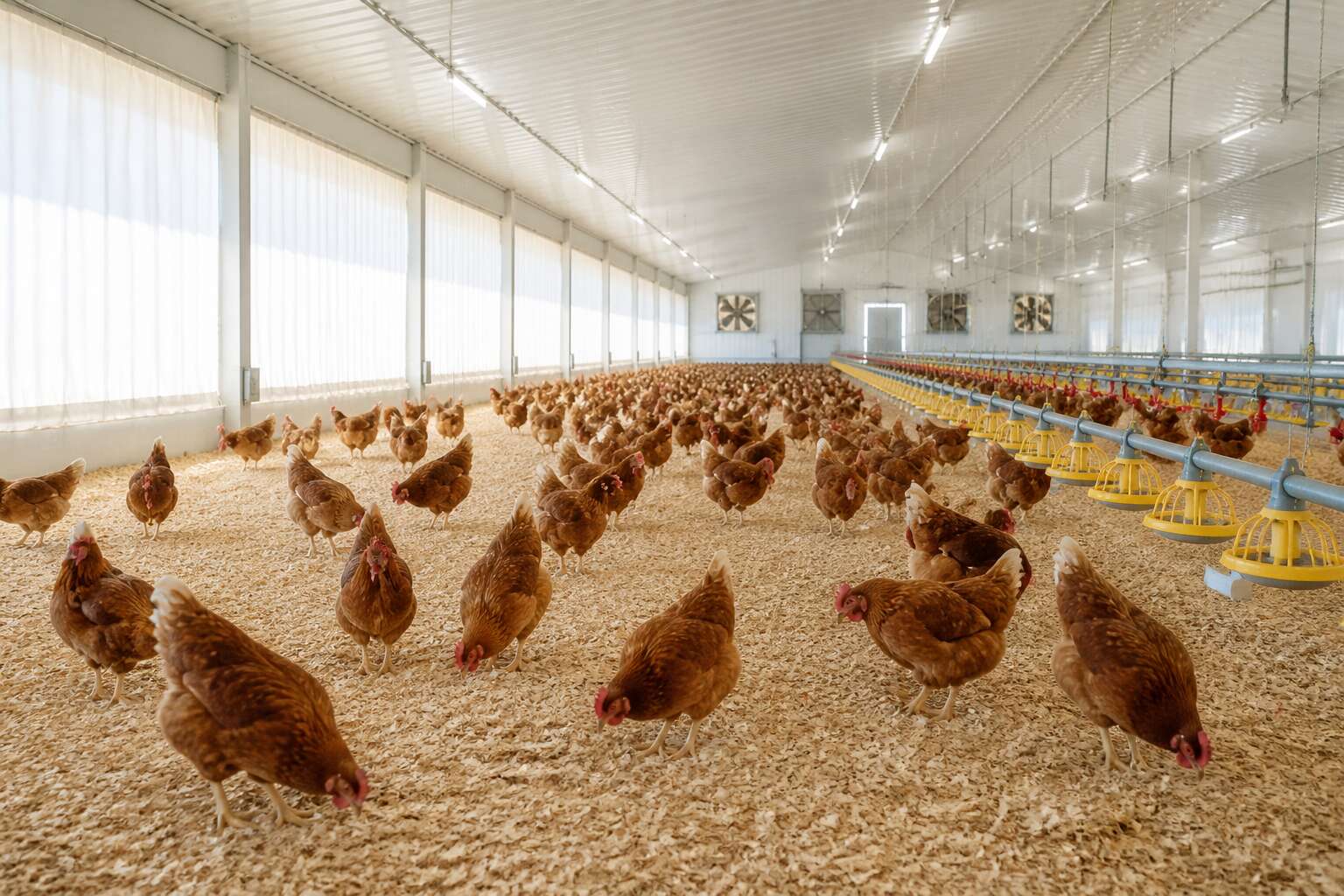
Why Curtain Sided Housing Improves Flock Performance
Regulating Airflow for Optimal Bird Health
Air moves through a poultry house in patterns that either support or stress the flock. Curtain sided housing gives the grower direct command over those patterns. When curtains open, fresh air enters low and forces stale air upward. When curtains close, the house holds warmth or restricts draughts during cold Highveld nights.
This control matters because birds have no sweat glands. Panting is their only cooling mechanism, and it costs energy. Regulating airflow with poultry house curtains reduces that loss. I have seen flocks maintain steadier feed conversion ratios than birds in static housing.
Proper airflow regulation provides:
- steady oxygen exchange
- removal of ammonia and carbon dioxide
- even floor temperatures across the house
Without this discipline, birds cluster, pant, and drink excessively. Poultry house curtains turn airflow into a managed resource.
Protecting Birds from Temperature Extremes
In South Africa, temperatures can swing by more than twenty degrees Celsius in a single day. Those swings hit birds hardest when housing offers no buffer. Poultry house curtains provide that buffer, standing between the flock and the Highveld sun or a sudden winter front.
Curtain sided housing traps a layer of still air near the walls. That layer resists thermal transfer, keeping interior temperatures stable. The curtain reflects radiant heat on a blazing afternoon and holds warmth at night.
Curtains also respond to urgency. A grower can drop them in minutes when a cold front arrives, or raise them before the morning sun gains strength. That speed is impossible with brick or timber!
- reduced mortality from sudden cold snaps
- lower incidence of heat stress related ascites
- more uniform growth despite seasonal shifts
I have walked houses in Mpumalanga where poultry house curtains made the difference between thriving and surviving.
Reducing Energy Costs Versus Solid Wall Construction
The economics of housing are brutal. Solid wall construction demands mechanical ventilation around the clock, and those fans consume electricity. Poultry house curtains let growers switch off the extractors and pocket the difference. In South Africa’s climate, that saving runs into thousands of rand per cycle. The birds notice too. Feed conversion ratios improve when birds aren’t panting or huddling, and that efficiency flows straight to the bottom line.
Flock performance follows the same logic:
– More uniform growth because temperatures stay stable across the full house width.
– Stronger immune response when birds aren’t spending energy on temperature regulation.
– Lower mortality during load shedding events, since curtains don’t need a generator to function.
I have walked houses in the Free State where curtain sided houses outperform their solid counterparts on growth rates. Poultry house curtains cut capital costs, reduce reliance on backup power, and extend the life of ventilation equipment. Those savings compound every single batch!
Enhancing Biosecurity with Controllable Openings
Biosecurity hinges on control. Poultry house curtains give the grower the ability to seal every opening within minutes when a nearby farm reports a health issue. That same curtain rolls back fully to expose the interior to sunlight and disinfectant during downtime. This dual capability supports disease prevention and faster recovery between cycles.
Flock performance improves because stress drops when birds face fewer environmental surprises. I have watched flocks recover more quickly in houses with poultry house curtains than in sealed buildings after a mild disease challenge. The rapid air exchange, achieved without mechanical assistance, keeps ammonia levels manageable.
1. Full sealing during high risk disease periods.
2. Full exposure for cleaning and drying between batches.
3. Natural light penetration that supports feed intake and activity.
Choosing the Right Fabric and Frame Materials
Polyethylene Versus Vinyl-Coated Polyester Weaves
Polyethylene’s low price tag is deceptive. The fabric turns brittle under South African UV rays, and you will replace it sooner. Vinyl-coated polyester weaves handle the sun better and resist tearing when a gust hits the veld. Frame materials matter too. Galvanised steel lasts decades; aluminium is lighter on your labour but dents easier. For poultry house curtains, the fabric and frame need to match your climate and maintenance appetite.
- Polyethylene: cheaper, shorter lifespan, prone to UV degradation
- Vinyl-coated polyester: higher upfront cost, superior tear strength, better longevity
Your choice depends on how often you want to replace things. The frame’s quality determines how long the whole system lasts.
UV Resistance and Light Transmission Levels
Under the Highveld sun, the difference between 5 percent and 20 percent light transmission is the difference between calm hens and a feather-pecking frenzy. Light entering through poultry house curtains influences feed intake, laying cycles, and even immune response. The fabric must balance brightness with UV resistance, because South African UV rays break down unprotected polymers within a single season!
Specific factors to weigh:
- Acrylic weaves hold colour and tensile strength after years of sun exposure.
- Lighter coloured fabrics reflect solar radiation but allow more visible light.
- Darker fabrics absorb heat and reduce glare, yet degrade faster without UV inhibitors.
Frame materials follow the same logic. Aluminium channels expand in the heat; galvanised steel stays true. The real test is how the entire assembly handles daily light cycles. Poultry house curtains that block too much light create dark, lethargic flocks, while overly transparent ones waste heat and cause stress.
Selecting Corrosion-Resistant Tracks, Winches, and Hardware
A curtain that flaps loose in a summer thunderstorm is worse than no curtain at all. The frame and hardware must match the fabric’s durability. For South African poultry house curtains, galvanised steel tracks resist the rust that coastal humidity and ammonia-rich air accelerate. Aluminium is lighter but expands in the Highveld heat, causing buckles at the mounting points.
The winch system deserves equal attention. A manual worm-drive winch holds position without slipping, while a brake handle prevents runaway drops during sudden wind. Choose stainless steel cables and pulleys with sealed bearings, because dust and feather dander will seize any unprotected moving part.
- Inspect track brackets for weld integrity before installation.
- Use self-tapping screws with rubber washers to prevent water ingress.
- Specify marine-grade hardware near evaporative cooling pads.
I have seen setups fail because the hardware was an afterthought. Properly selected components let you adjust your poultry house curtains in seconds, not hours.
Fire Retardancy Ratings and Safety Compliance
Fire retardancy sets the boundary between a contained incident and a total loss. South African poultry house curtains must meet specific flame spread classifications under SANS 14177.
A polyester weave treated with a phosphorous-based compound self-extinguishes when the ignition source is removed. Untreated material continues to burn and drips molten residue. The frame contributes equally. Aluminium conducts heat and softens during a blaze, while galvanised steel holds its shape.
- SANS 14177 covers flame resistance testing
- EN 13501 provides European equivalency
- CE marking indicates third-party verification
Suppliers publish test certificates for each fabric batch, and those certificates list the exact rating. These ratings translate directly into evacuation time and structural survival. Compliance with fire retardancy standards is the difference between a curtain asset and a liability.
Custom Sizing, Seams, and Reinforced Hem Options
Selecting poultry house curtains starts with matching the weave density to your local wind load. A tighter weave handles gusts better but adds weight to the roll. For the frame, hot-dip galvanised square tubing resists bending and does not fatigue near hinge points like lighter profiles. That matters on exposed Highveld farms.
Custom sizing eliminates gaps that let draughts in. Each curtain should be cut to the exact opening, with allowances for thermal expansion. Seams need to be double-stitched or heat-welded, depending on the fabric. A reinforced hem adds a pocket for the bottom bar, which stops the curtain from flapping loose in a storm.
- Check stitching spacing on every delivered batch
- Request a hem pocket wide enough for your bar diameter
- Measure after installation, not from the brochure
I have seen curtains fail at the seam long before the fabric wears out. Attention to these details is what separates poultry house curtains that last from those that tear out in the first summer.
Comparing Manual and Automated Operation Systems
Simple Cable and Winch Setups for Smaller Flocks
Poultry house curtains on a smaller operation often come down to a simple choice. I have watched flocks of five hundred thrive under a hand crank and a well maintained cable. The rhythm is reliable, and the upfront cost stays modest. For a growing South African farm, a manual winch offers direct control and minimal maintenance, letting you react to a sudden Highveld storm without depending on electricity.
Automated systems introduce a different kind of calm. A thermostat or timer adjusts the curtain while you handle feed or rest. Yet automation demands sensors, motors, and rewiring, which can complicate a simple poultry house curtains setup.
- Manual cable systems suit smaller flocks with daily oversight.
- Automated systems earn their keep when you manage multiple houses.
- Galvanised cables and sealed winches determine longevity in either case.
Dust and humidity punish cheap hardware, so choose components that resist corrosion and match your flock size.
Rack and Pinion Drives for Uniform Curtain Movement
When a farmer chooses between a manual winch and an automated system, the decision often reveals more about their temperament than their flock size. Manual operation rewards the vigilant, those who enjoy the morning ritual of reading the sky and adjusting accordingly. Automation, however, offers its own quiet luxury, freeing you to attend to other pressing matters while the sensors do the worrying.
Rack and pinion drives change the equation entirely. Unlike cable systems, which can slacken and pull unevenly, a rack and pinion drive moves every section of curtain in disciplined unison. This uniform movement prevents the frustrating scenario of one end gaping while the other remains sealed.
Consider the operational differences:
- Manual systems demand physical presence and a weather eye.
- Automated rack and pinion setups move poultry house curtains in precise increments.
- Manual adjustments suit irregular, hands-on schedules.
For South African operations juggling multiple houses, the rack and pinion approach reconciles both philosophies, offering mechanical certainty with optional automation. Poultry house curtains deserve this level of deliberation, as the system you choose shapes daily workflow for years.
Thermostats, Timers, and Multi-Stage Climate Controllers
Thermostats and timers remove the guesswork from curtain management, but their fidelity differs. A thermostat responds to actual temperature shifts inside the house. A timer follows a schedule, which suits predictable South African days but stumbles when a cold front arrives unannounced. Multi-stage climate controllers combine both inputs, layering in humidity, wind speed, and static pressure to adjust poultry house curtains in incremental steps.
Consider what each system demands from you:
1. Thermostats react to real-time conditions but require calibration.
2. Timers deliver consistent routines yet ignore weather anomalies.
3. Multi-stage controllers reconcile multiple factors, though they carry higher installation costs.
Manual oversight still matters, because sensors fail and loadshedding interrupts power. The most effective operations treat automation as a first responder, not a final authority on poultry house curtains.
Integrating Static Pressure and Wind Speed Sensors
Manual operation keeps you close to the flock. You feel the afternoon heat, watch the dust rise, and decide when to shift the poultry house curtains by feel. That instinct has value. But wind can change faster than you can walk the length of the house. A berg wind arrives without warning, and the house loses heat through a gap you did not see.
Automated systems read the same moment through static pressure and wind speed sensors, adjusting the poultry house curtains before you notice the shift. Here is what changes in your daily rhythm!
- Manual systems ask you to be present: check the ropes, feel the breeze, judge the pressure.
- Automated systems measure pressure differentials and gusts continuously, responding in increments you would miss.
Sensors fail. Loadshedding interrupts power. You still need to know how to raise a curtain by hand, and you will still walk the house each morning. But integrating static pressure and wind speed sensors means you are not the only one paying attention.
Emergency Backup Controls for Power Outages
In South Africa, loadshedding makes emergency backup unavoidable. Manual systems have one unbreakable advantage: they work when the grid does not. Automated systems, however, leave you reliant on inverters or batteries to keep the poultry house curtains moving.
A power outage does not mean the weather pauses. Backup controls should be rehearsed, not improvised. For automated setups, keep the controller alive with:
- A dedicated battery bank for the control unit and drive motor
- A manual override handle on the gearbox
- Clearly marked cranks at each curtain position
When the electricity fails, the people on site matter more than the hardware. Practice the fallback steps until they become muscle memory. Choose a system your team can operate in the dark, because that is exactly when they will need to.
Installation, Sealing, and Tension Best Practices
Proper Overlap of Curtain Panels to Minimize Leaks
A gap of 2 centimetres under a curtain can ruin the climate inside a poultry house. Installation, sealing, and tension matter. Poor installation defeats the purpose of poultry house curtains. Track alignment deserves the first check. A warped track forces uneven running, causing premature wear.
Sealing is the next step. The bottom edge must sit flush against the wall when closed. A weighted hem keeps the panel down in windy conditions, preventing flapping and tear at the anchor points. The common leak areas are:
- End caps at the sidewall junction
- Joint seams between panels
- Top attachment points along the header
Tension matters more than most farmers realise. Too loose allows the fabric to billow. Too tight stresses the seams. The winch should be adjusted so the curtain moves smoothly without resistance.
Proper overlap of poultry house curtains is the final safeguard. Adjacent panels should overlap by at least 15 centimetres. Seams should be staggered so they do not align with structural posts.
Setting Up Eave Inlets and Deflectors for Incoming Air
Installing eave inlets above the curtain line changes how air moves across the house. The inlet gap should match the static pressure, not guesswork. A deflector set at 30 degrees forces incoming air toward the ridge, mixing with warm air before it falls.
Sealing also applies to the inlet frame. Gaps between the eave and the wall create unwanted drafts. Check the tension on the curtain’s winch after any adjustment. Loose fabric near the inlet adds turbulence, while overtightening distorts the track.
- Set deflectors at 30 to 45 degrees for cold weather
- Use 15 degrees for hot weather to boost cooling
Inlet openings should track with curtain height. If the curtain rises 5 centimetres, the inlet should open a similar amount. Poultry house curtains work best when the air path from inlet to bird level stays smooth.
Adjusting Tension to Prevent Flapping and Wear
Poorly tensioned poultry house curtains fail faster than any other component. The fabric whips, the hem frays, and the track wears unevenly. I have seen South African farmers lose entire flocks to a curtain torn in a storm because the winch was left loose.
Installation begins with the track. Fix it level, and check that the curtain drops straight. A twisted track forces fabric to ride sideways. Seal the perimeter. Gaps around the eave and end walls invite drafts that flutter the curtain.
- Check tension after rainstorms and temperature swings.
- Adjust the winch until the fabric sits flat.
- Inspect the hem for rubbing marks.
Flapping shortens the life of poultry house curtains. Wind catches a loose panel, stretching the weave and tearing the stitching. Tighten just enough to stop movement, but not so much that you distort the frame. A calm curtain lasts seasons; a flapping one lasts hours.
Installing Rodent Guards and Predator Deterrents
Rodents target the smallest gap around poultry house curtains. A mongoose slips through a thumb width opening, and rats climb the winch cable. Installing a rodent guard along the bottom hem stops burrowing. Galvanized mesh buried 200 mm deep works best. Predator deterrents vary by region:
- Electric fencing along the eaves
- Motion activated lights near the track ends
- Smooth metal collars on corner posts
The curtain itself must seal tightly. A loose hem invites weasels and snakes. The winch is adjusted until the fabric sits flush against the guard. Sealing the track ends with foam blocks entry points. Tension checks follow rainstorms, as wet fabric stretches. The perimeter is inspected weekly for dig marks. Poultry house curtains function properly when the bottom edge meets the buried mesh. The mesh guard and the curtain form one continuous barrier.
Common Installation Mistakes and How to Avoid Them
Most poultry house curtains fail because of installation day haste. A sagging cable or a misaligned track gets worse with every cycle. Confirm alignment, secure everything, and run a full open and close test before birds arrive.
Sealing demands patience. The bottom hem must meet the rodent guard flush, and the track ends need foam blocks pushed deep into the channel. Water pools where the seal gaps, and pooled water pulls the fabric off line.
- Check tension after every storm, because wet polypropylene stretches.
- Recheck winch brakes at the same time.
Mistakes with poultry house curtains usually follow haste. Skipping the corner post collars or leaving a gap at the eaves causes pressure leaks, then birds suffer drafts. Give each winch a quarter turn past snug, no more. Overtightening distorts the curtain profile.
Winterizing and Wind-Proofing Exterior Flaps
Winter arrives and your poultry house curtains suddenly develop opinions about draughts. The bottom hem needs to sit flush against the rodent guard, not hover above it like a shy guest. Foam blocks in the track ends shrink as temperatures drop, so push them deeper or replace them with denser material.
In my experience, wind-proofing exterior flaps demands honest tension checks. Wet polypropylene stretches, but cold polypropylene stiffens. Neither state cooperates with a winch that was snug in summer. Give each winch a quarter turn past snug, no more! Then observe the curtain during a gusty afternoon. It should ripple, not snap.
Some operators use an overlapping flap for wind protection.
- Overlap the main curtain by at least 100 mm.
- Recheck anchor points after every storm.
- Apply low-temperature grease to winch gears.
That routine keeps everything functional when weather turns hostile.
Ongoing Maintenance and Replacement Planning
Routine Inspection Checklists for Fabric and Seams
A fabric tear rarely announces itself at feeding time. You catch it only after a gust turns a clean curtain into a flapping hazard. That is why I schedule routine inspections of poultry house curtains like feeding, not like an annual holiday. I walk every seam, every stitched edge, with my palm flat against the material. You cannot trust your eyes alone, because polyethylene weaves hide abrasions until they split.
1. Check the top hem and bottom hem for missing stitches.
2. Run your hand along every vertical seam for pinhole leaks.
3. Look for discoloration that signals UV breakdown.
Most curtain failures are predictable. UV exposure and tension do the damage on a timer. If you track when each panel was installed, you know when to replace it before it gives out. I keep a simple log. When a curtain reaches three years, I order spare panels ahead of the storm season. That planning saves you from emergency repairs on a Sunday afternoon.
Lubricating Tracks, Winches, and Drive Chains
Friction wears down machinery. A winch that moves smoothly today can seize tomorrow if the drive chain runs dry. Dust and ammonia residue mix into a paste that grinds metal parts down. Lubrication is the only defence, and routine wins over reaction.
Track lubrication matters most before the storm season. I use a silicone based spray on the tracks and heavy grease on the winch gears. One pass with a rag to remove old buildup, then fresh lubricant.
– Wipe each track channel clean before applying new lubricant.
– Oil drive chains with a drip applicator, not a spray that misses the pins.
– Check winch gear teeth for wear while you are there.
Caked lubricant attracts dust. Clean first, then grease. A dry chain snaps at the worst moment. Poultry house curtains depend on these small mechanical rituals.
Cleaning Protocols to Prevent Mold and Mildew
The mold that appears on poultry house curtains comes from condensation, dust, and organic debris. Left alone, it stains and weakens the fabric. The protocol is simple: wash with a non-abrasive detergent, rinse thoroughly, and let the curtain dry completely before closing it. I have found that a morning cleaning dries faster than an afternoon one.
- Inspect seams and hems while the curtain is still wet, because tears show up clearer.
- Use a soft bristle brush to work the detergent into Z-fold areas.
- Never force dry with heat, the film layers can separate.
Replacement planning starts with these same cleanings. Once you see yellowing that does not wash out, or a spongy feel near the bottom edge, those poultry house curtains are telling you their time is short. Track costs now, and swap panels before the next storm season, not during it.
Identifying Sun Damage, Tears, and Loose Anchors
The South African sun does more damage to poultry house curtains than any storm. Ultraviolet light breaks down the polymer bonds, even in treated panels. I check the top edge first, since that section gets the most direct exposure. A chalky residue or powdery feel means the surface is degrading.
Tears show up at different times. A clean rip near a seam usually comes from repeated winching. A frayed bottom edge comes from rubbing against the track. Loose anchors are easier to spot: the curtain line goes slack, or the cable vibrates in a moderate wind.
- The hem feels rough in spots where the fabric has rubbed against the wall.
- Small tears that stay the same size for two weeks are usually stable.
- A loose anchor shows itself when the curtain line slackens overnight.
When tears cluster in one section, start replacement planning. Poultry house curtains that lose their anchor points waste more heating than a new panel costs.
Deciding When Replacement Beats Repair
Somewhere between routine inspections and emergency fixes lies the real skill: knowing when to walk away from the repair kit. I have watched farmers spend three weekends reinforcing the same section of curtain when a full panel swap would have paid for itself in a single winter. Ongoing maintenance keeps your poultry house curtains functional, but it cannot restore fabric that has lost its structural integrity.
Replacement beats repair when the material no longer flexes. If the fabric crinkles like paper or refuses to lie flat after tension is released, no patch will hold. Consider these triggers for a full replacement:
- Tears longer than twenty centimetres that reappear within a month
- Stiff, brittle sections that crack when folded
- Anchor points that pull loose despite new hardware
I always track repair frequency on a simple log. Three fixes on one panel in a single season means the structural limit is gone. Your poultry house curtains need to handle daily movement, wind pressure, and thermal cycling. A patched curtain that fails during a cold snap costs more in lost heat than a new panel ever will.
Extending Service Life with Proper Storage in Off-Seasons
Off season storage is the unsung hero of curtain longevity. I have seen curtains that spent summer rolled in a damp corner, and they never recovered. The fabric may look fine, but the threads are already planning their escape.
Ongoing maintenance does not stop when the birds leave. Proper storage requires a few non-negotiable steps:
- Clean and dry every surface to prevent mildew growth.
- Roll panels around a PVC pipe instead of folding them.
- Raise the bundle off the floor to avoid rodents and damp.
Check for stiff spots before you store, as those will only worsen. Replacement planning should start during storage. When you unroll poultry house curtains in spring, inspect the crease points. Cracks or resistance to movement signal that the panel has reached its limit. The first heatwave will confirm it.
Cost Analysis and Economic Return on Investment
Upfront Costs Per Square Foot of Curtain Systems
Upfront costs per square foot for curtain systems often shock South African poultry farmers. A typical installation ranges from R45 to R85 per square foot, depending on fabric grade and automation level. Yet the longer ledger tells a sweeter story! Poultry house curtains that allow precise ventilation reduce mortality rates and improve feed conversion ratios, directly enhancing your bottom line. Consider the payback period:
- Labour savings from automated winches cut daily management hours.
- Power bills shrink when curtains harness natural airflow rather than mechanical fans.
- Faster flock turnover means more revenue cycles per year.
Within two seasons, most operations recover their initial outlay. The true economic return emerges through consistent climate control, not lower construction costs alone. South African producers who track these metrics find curtain systems outperform rigid walls on pure arithmetic.
Lower Heating and Cooling Bills Across Seasons
Seasonal energy bills often determine profitability for South African poultry producers. On the Highveld, winter nights drag on and summer heat peaks, forcing heating and cooling systems into overdrive. Poultry house curtains provide a release valve. By sealing the house at night, they hold warmth in and shorten brooder runtime. When temperatures climb, opening the curtains lets the natural breeze replace fan-driven air.
The economic return on investment shows up in the monthly utility statement. A well-managed curtain system can cut electricity consumption by 15 to 25 percent across the year.
- Reduced fan usage lowers kilowatt-hour demand.
- Heating cycles shorten, saving diesel and electricity.
- Cooling pads run less often, cutting water and power costs.
Over three seasons, those savings usually exceed the initial purchase price. That makes poultry house curtains an investment in operational resilience, and the arithmetic is straightforward.
Preventing Ventilation-Related Mortality and Weight Loss
Every dead bird is a line item that never makes it to market. Ventilation failures do not announce themselves. They show up as elevated ammonia, damp litter, and birds that stop eating. Mortality climbs. Surviving birds lose condition, and weight gain stalls.
The cost analysis for poultry house curtains must include these losses:
- Carcass value lost to mortality
- Feed consumed by birds that die before market
- Extended grow-out days from stalled weight gain
A flock that loses even two percent to poor ventilation forfeits thousands of rand in saleable meat. The arithmetic changes when you install proper curtains. One prevented mortality event can offset a meaningful portion of the installation cost. Over several flocks, the return on investment becomes undeniable.
Warranty Coverage and Long-Term Durability Comparisons
The real price of poultry house curtains is measured over a decade, not at the invoice date. A cheap installation can cost triple in replacement fabric, failed winches, and lost bird performance. The economic return, by contrast, comes from avoiding those failures. Compare the warranty terms before you sign: some manufacturers cover only material defects, while others include seam integrity and hem reinforcement.
For a fair comparison, look beyond the headline price per square meter.
- Check the guaranteed lifespan of the fabric under UV exposure.
- Confirm whether the warranty is prorated or full value.
- Ask about coverage for corrosion on tracks and hardware.
That last item matters most in South African coastal regions. A curtain system with a five year warranty and a durable weave will often outperform a cheaper option over three flocks. Calculate the cost per usable season, not the upfront rand. When you divide the total investment by the expected years of service, poultry house curtains with robust warranty coverage consistently show a lower true cost. Long term durability is the factor that turns a capital outlay into a net gain.
Utility Rebates and Grants for Climate-Smart Upgrades
Somewhere between the third load of feed and the first cold front, the arithmetic of poultry house curtains starts to look suspiciously like a romance novel. The initial quote is the meet-cute. The real plot twist appears when the electricity bill arrives. Every square meter of curtain that opens and closes correctly is doing the job of an HVAC system that never asks for overtime. Over a full production cycle, the savings in heating and cooling are less a gentle nudge and more a firm pat on the back for your bank manager.
Then there are the quiet benefactors. South African municipalities and agricultural schemes occasionally offer rebates or grants for climate-smart upgrades. Yes, you read that right. Someone is willing to pay you to be sensible. These incentives are not always advertised with fanfare, so you have to dig around.
- Check Eskom’s demand side management programmes for ventilation related efficiency.
- Ask your local agricultural union about drought resilience grants that cover curtain retrofits.
- Look for provincial funds aimed at reducing energy use in poultry operations.
Stack those benefits against the cost of poultry house curtains and the return on investment becomes a question with a rather boring answer. It pays for itself. Twice. Then it buys you a braai.


0 Comments