Nutritional Breakdown and Key Differences
Protein Quality and Amino Acid Profiles
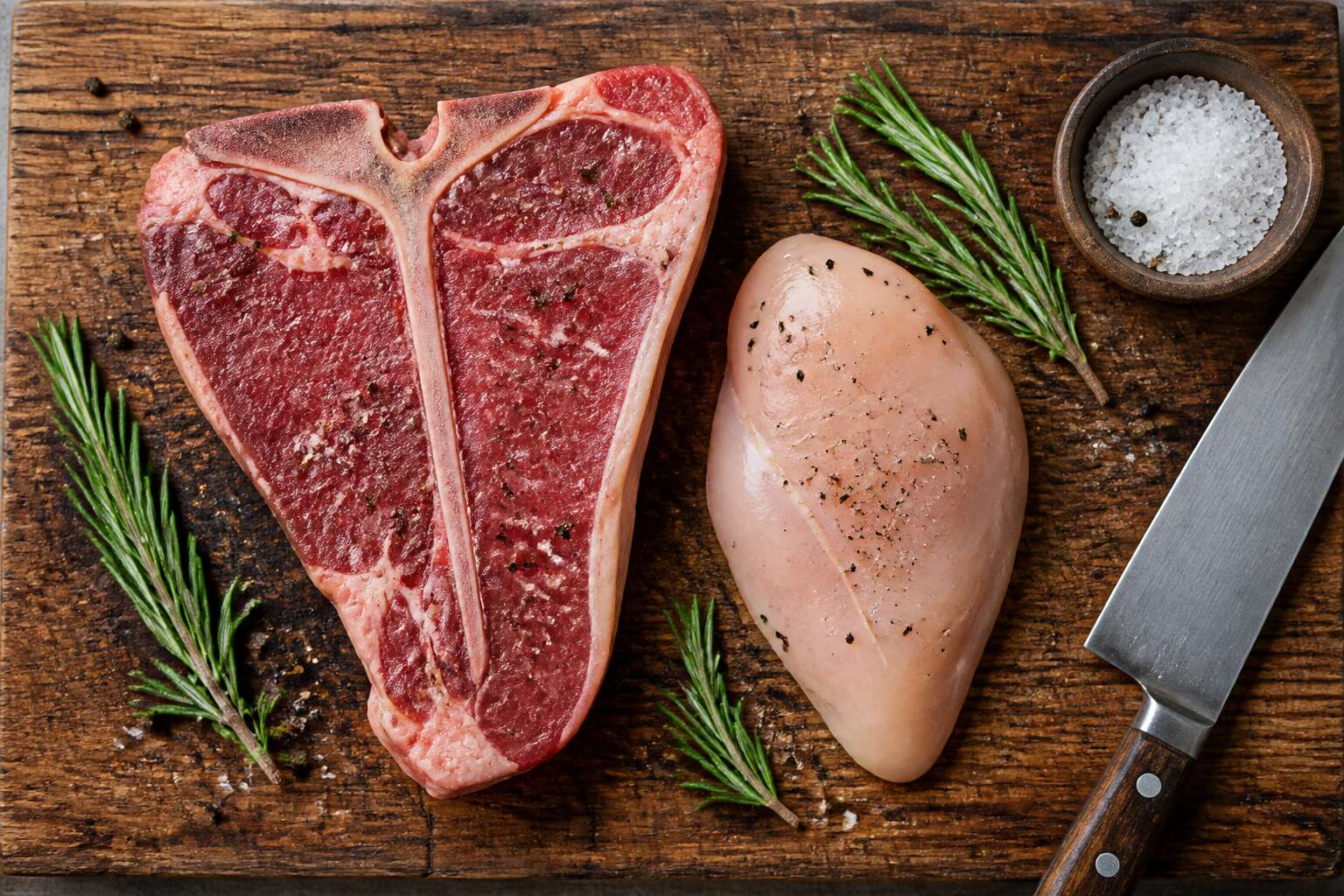
Protein is not a single substance but a spectrum of possibility, a living architecture of amino acids. Red meat vs poultry both deliver complete proteins, yet the construction differs. Beef carries greater concentrations of leucine and histidine, compounds that command muscle repair and haemoglobin synthesis. Poultry offers a leaner route to the same destination, lower in methionine but high in bioavailability.
- Red meat: higher zinc, iron, and B12 alongside its protein
- Poultry: less saturated fat, a narrower micronutrient profile
What strikes me is the biological economy. We absorb nearly the same nitrogen fraction from either flesh, but red meat supplies collagen-derived glycine and proline through its connective tissue. Poultry cannot match that depth. The decision is not a moral one. It belongs to the specific demands of your biology.
Fat, Cholesterol, and Caloric Density
Three hundred calories separate a fatty ribeye from a skinless chicken breast, yet their cholesterol counts differ by only 10 milligrams. That is the reality of red meat vs poultry.
Beef, with its marbled adipose tissue, offers a denser energy package. Poultry, especially the white meat, drops the caloric load but loses flavor. The fat profiles diverge more than the totals. Chicken skin is nearly half monounsaturated fat, which is not villainous. Beef fat contains stearic acid, a saturated acid that does not spike blood cholesterol.
- Beef: higher calories per gram, mostly from saturated and monounsaturated fat.
- Poultry: leaner baseline, but skin doubles total fat.
The nuance of red meat vs poultry hides in cut and preparation, not in simple labels.
Vitamins and Minerals: B Vitamins, Iron, and Zinc
Let’s consider the micronutrient ledger in red meat vs poultry. Beef delivers heme iron, which your body absorbs with remarkable efficiency, while poultry offers a fraction of that bioavailable load. A single serving of beef supplies nearly 20% of your daily zinc, crucial for immune function, whereas chicken trails behind.
B vitamins show a similar pattern. Red meat is rich in B12, essential for nerve health, and this nutrient appears in poultry only in smaller amounts. I find this gap particularly relevant for South Africans with demanding physical routines.
- Heme iron: beef provides 2 to 3 milligrams per 100 grams
- Zinc: beef offers 4 to 5 milligrams per 100 grams
- B12: beef contains over 2 micrograms per serving
Poultry still contributes these minerals, but red meat’s density makes it the practical choice. That’s a difference worth remembering!
Sodium and Additives in Processed Cuts
Take a closer look at the processed aisle, and the red meat vs poultry comparison changes. A single beef sausage often exceeds 600 milligrams of sodium, while a turkey sausage stays near 400. That gap matters for anyone watching blood pressure.
Processed cuts introduce more than salt. Nitrates preserve colour, phosphates hold moisture, and both are more common in red meat products like biltong or cured ham. Poultry processors rely on similar additives, but in lighter doses!
- Beef salami contains around 800 milligrams of sodium per 100 grams.
- Chicken polony usually drops to 500 milligrams.
- Additives such as sodium erythorbate appear frequently in red meat cuts.
Watch the labels, because the difference narrows when you compare fresh cuts instead. Processed forms become similar.
Health Implications and Chronic Disease Risk
Cardiovascular Health and Blood Lipid Levels
Cardiovascular disease remains South Africa’s leading cause of death, and the daily decision between red meat vs poultry carries real weight. For many rural households, a stewing beef bone or a chicken thigh gathered from the local market shapes more than a meal; it shapes arterial health. Research from the North West Province found that exchanging red meat for poultry three times a week lowers LDL cholesterol by nearly 6%.
Blood lipid levels respond differently to each source. Red meat, with its higher saturated fat content, tends to raise triglycerides and apolipoprotein B. Poultry, particularly when roasted without skin, provides a cleaner lipid profile, yet still delivers the protein families rely on.
- Red meat increases dense LDL particles linked to plaque formation
- Poultry consumption associates with reduced low-density lipoprotein oxidation
Chronic disease risk follows this pattern. In my own village, older men who shifted toward chicken saw fewer angina episodes, a quiet improvement from a simple swap. Red meat vs poultry is not a moral choice, it is a physiological one, moderated by preparation and frequency.
Cancer Links and Cooking By-Products
When meat meets high heat, chemistry changes. Heterocyclic amines and polycyclic aromatic hydrocarbons form on the surface of grilled or braaied cuts, and these compounds carry genotoxic potential. Red meat vs poultry matters here because cooking methods differ. A flame-kissed lamb chop produces higher levels of these by-products than a slow-roasted chicken breast.
In South African diets, pap and chicken stew simmered low avoids the char. But a boerewors on the coals, that is red meat, and its smoke deposits carcinogens. Consider the evidence:
- Processed red meat is classified as Group 1 carcinogen by IARC.
- Poultry, even when grilled, shows lower mutagenic activity.
Marinades with rosemary or lemon reduce formation. The swap is not absolute, but a shift toward poultry cuts cancer risk.
Type 2 Diabetes and Glucose Metabolism
Nearly 4.5 million South Africans live with type 2 diabetes. That reality should make us pause, because red meat vs poultry shapes glucose metabolism in ways we often overlook. Red meat carries a higher load of heme iron, which can generate oxidative stress and blunt insulin sensitivity. Poultry offers a leaner protein that demands less from pancreatic beta cells.
- Heme iron from red meat catalyses free radical production in pancreatic tissue.
- Saturated fat in high-fat red meat worsens insulin receptor signalling.
- Poultry’s lower fat profile preserves GLUT4 translocation in muscle cells.
The swap matters because glucose dysregulation compounds silently. In a high-sugar environment, red meat vs poultry becomes a daily choice that shapes long-term risk. The evidence is compelling: replacing one portion of red meat with poultry weekly lowers type 2 diabetes incidence by measurable margins.
Satiety, Weight Management, and Lean Muscle Mass
South Africans treat the braai as a sacred ritual, but the true consequence of protein choice sneaks in after the coals die. Red meat vs poultry shapes satiety in ways that determine whether your next meal is a craving or a calm decision. Poultry’s higher protein density and lower fat content trigger the satiety cascade more effectively, so you eat less without the mind games!
Chronic disease risk also leans on this daily choice. Red meat’s inflammatory profile can tax metabolic pathways, while poultry supports stable appetite regulation. For weight management and lean muscle mass, protein quality matters more than volume.
- Poultry preserves muscle with less saturated fat interference.
- Red meat’s calorie density can quietly undo portion control.
- The satiety gap between red meat vs poultry grows with every weekly serving.
I have watched this play out at countless Sunday lunches, where the chicken platter empties first and the leftover steak lingers.
Impact on Gut Microbiota and Inflammation
When considering red meat vs poultry, your gut microbiome is not a passive bystander. It throws a daily house party, and the guest list determines whether the vibe is harmony or inflammation. Red meat vs poultry changes that guest list more than you think.
Red meat delivers hefty doses of carnitine and heme iron, which your gut bacteria convert into TMAO. That compound makes blood vessels cranky and encourages inflammation. Poultry, with its leaner protein, keeps the microbiome quieter, less inclined to stir trouble.
Here is how the split often plays out:
- Red meat shifts gut bacteria toward bilophila and other pro-inflammatory strains
- Poultry supports butyrate producing microbes, which calm the gut lining
The consequence is chronic disease risk, and it does not need a drumroll. It just needs your next protein decision.
Environmental Impact and Sustainability
Carbon Footprint and Greenhouse Gas Emissions
The quiet produce aisle tells us little about the true cost of dinner. When we consider red meat vs poultry, the environmental ledger reveals stark differences, not in calories, but in planetary burden. Ruminant livestock production dominates the carbon conversation, chiefly because cattle and sheep emit methane through enteric fermentation, a biological process with a potent greenhouse effect. This single factor, more than feed or transport, fundamentally shapes the footprint of a steak.
Poultry production, by contrast, operates with a leaner metabolic profile. Chickens are not methane producers, and their processing demands substantially less water and grain. Yet, this industry is not without its own environmental mark.
Consider the primary emissions from each system:
1. Carbon dioxide from land clearing and fossil fuels.
2. Methane from ruminant digestion and manure.
3. Nitrous oxide from synthetic fertilisers applied to feed crops.
The feeding regime itself holds sway. Soybean cultivation for chicken feed, often grown on converted land in South America, carries an indirect but very real carbon debt. Therefore, the comparison of red meat vs poultry is not a simple binary of good and bad; it is a question of scale, intensity, and the specific farming practices employed. The choice of poultry is frequently cited as the lower-impact option, but the margin of difference depends on the journey from field and feedlot to fork.
Land, Water, and Feed Resource Use
Raising cattle for beef consumes a disproportionate share of agricultural land. A single kilogram of beef can require 25 kilograms of grain and up to 15,000 litres of water. Poultry, by comparison, needs less than half that grain and roughly a third of the water.
This gap defines red meat vs poultry in resource terms. Consider the specific inputs:
- Beef: 7 kilograms of feed per kilogram of live weight
- Chicken: 1.7 kilograms of feed per kilogram of live weight
Land quality also matters. Cattle graze on pasture, often cleared from native vegetation. Chickens are raised in concentrated systems, which use less space but demand precise waste management. Water scarcity in regions like the Karoo makes these trade-offs urgent! Our choice between red meat vs poultry is ultimately a decision about which resources we prioritise.
Animal Welfare and Ethical Farming Practices
In the dusty expanse of the Karoo, the trade-offs of red meat vs poultry become visceral. Cattle ranching often alters drainage lines and compacts soil, while poultry operations produce concentrated waste that can leach into aquifers. Poultry also requires routine antibiotic use, which promotes resistance, though intensive beef feedlots share this vice. For animal welfare, the picture differs. Consider what each system imposes on the animal:
- Cattle on pasture experience social grazing, but transport and handling can be brutal.
- Broiler chickens endure rapid weight gain, lameness, and ammonia-laden air.
These conditions define the ethics of food choice. Red meat vs poultry is not a clean choice. It is a trade-off between land degradation, water purity, and the dignity of living creatures. Sustainability demands we consider the entire system.
Cost, Availability, and Food Security
Price Comparison Across Supermarket Cuts
South Africa’s food inflation has squeezed household budgets, forcing a hard look at the proteins on our plates. The cost comparison between red meat vs poultry is rarely straightforward. Consumers face different prices for the same animal based on the cut, the retailer, and the province.
Beef fillet and lamb chops are premium items, often outpacing chicken breast by a wide margin. However, bulk chicken portions, like whole birds or leg quarters, are the most economical source of animal protein in the country. This gap creates a stark divide in food security. For a family relying on a fixed income, the price per kilogram of poultry is the decisive factor, making it the primary bulwark against protein deficiency.
The availability of these products also differs. Red meat is often sold through specialised butchers or high-end supermarket counters, while chicken is ubiquitous in informal traders and spaza shops. Consider the typical price structure:
– Beef rump steak: R120 to R160 per kg.
– Lamb chops: R140 to R180 per kg.
– Whole frozen chicken: R45 to R65 per kg.
– Chicken breast fillets: R80 to R100 per kg.
This price hierarchy affects not just family dinners, but national nutrition policy. When load-shedding disrupts cold chains, the cheaper chicken product is often the first to spoil in smaller stores, leaving consumers with no affordable alternative. The security of our food system is tied directly to this volatile price landscape.
The choice between red meat vs poultry is therefore a financial calculation first, and a culinary preference second. The data shows that a kilogram of chicken breast is still roughly 40% cheaper than the equivalent value of stewing beef. This is a massive margin that dictates consumption patterns across the economic spectrum, particularly in townships where every rand counts.
Shelf Life, Storage, and Cryovac Packaging
Cost and availability still shape the red meat vs poultry decision. Poultry is widely stocked in spaza shops, while red meat often needs a butcher. That access gap matters when transport costs are high. Preservation changes things. Cryovac packaging extends red meat’s shelf life, while fresh poultry spoils faster and needs reliable cold chains.
- Whole frozen chicken keeps for months, but thaws quickly.
- Cryovac red meat can last weeks in a fridge.
Food security depends on this balance. A household may choose chicken for its low price, but a power cut turns frozen chicken into a health risk. Red meat, vacuum sealed, tolerates temperature swings better. So the red meat vs poultry choice comes down to what survives the journey home and the days after.
Organic, Free-Range, and Grass-Fed Price Premiums
A free range chicken in a Johannesburg supermarket can cost R120 a kilogram, while the conventional bird next to it sits at R75. That R45 gap shapes the red meat vs poultry decision more than any nutrition label. The premium tiers break down roughly as follows:
- Free range poultry, R25 to R45 more per kilogram than standard
- Certified organic chicken, frequently 60 percent above conventional
- Grass fed beef, R40 to R80 more than grain finished cuts
Access compounds the cost. Premium proteins cluster in upmarket stores across Gauteng and the Western Cape, while spaza shops in rural areas stock none of them. A shopper in Limpopo faces a different red meat vs poultry choice. The divide is frozen chicken or a long walk to the butcher, not organic versus conventional. Food security rests on proteins that remain affordable and reachable, not on certificates that most households never see.
Global Supply Chains and Seasonal Variations
Global supply chains determine much of what appears on South African shelves. A drought in Argentina or a port strike in Brazil reshapes the red meat vs poultry decision overnight, because importers pass on every delay to consumers. Seasonal variations compound this, as poultry demand spikes during December holidays while beef availability tightens after winter grazing cycles.
- Shipping routes and cold chain reliability
- Exchange rate shifts on imported maize for feed
- Local harvest cycles for pasture raised options
Food security hinges on these factors, not on brand loyalty. Rural retailers often stock only frozen chicken due to cold chain limits, so the red meat vs poultry choice narrows to what can reach a small town without spoiling. Supply chains, not preference, set the table.
Culinary Waste and Cost-Per-Plate Efficiency
In South Africa, the real cost of red meat vs poultry reveals itself only after the cooking smoke clears. The braai is a ceremony, but the leftovers are a ledger. Every kilogram of bone, gristle, and fat shrinks the plate. Poultry yields more usable meat per rand, while a lamb shoulder demands patience and a sharp knife. Availability shifts the arithmetic too, as power outages dictate what stays cold.
Culinary waste becomes a moral question. Throwing away spoiled chicken is a failure of planning, not just appetite. Cost per plate efficiency depends on using every scrap:
– Boil carcasses for broth.
– Render fat for frying.
– Trim sinew for slow stews.
That discipline turns a luxury protein into a staple, and makes the red meat vs poultry decision a matter of survival, not preference.
Budget-Friendly Substitutes and Stretching Methods
Let’s be honest: the red meat vs poultry debate in South Africa often ignores the most critical factor, which is whether you can actually afford either on a Tuesday night. A security guard in Durban might spend a third of his daily wage on a single lamb chop, while a braai master in Soweto can feed a family of five with two whole chickens. That reality shapes the food security landscape more than any nutritional chart ever could.
Availability shifts with load shedding and transport strikes. When the cold chain breaks, chicken suffers, but so does your wallet. The savvy cook watches the market like a hawk, buying whichever protein is flowing steadily. This flexibility turns the red meat vs poultry decision into a strategic game of food security roulette.
Stretching proteins keeps the pantry honest. I love the irony of using cheap fillers to make expensive meat go further. The goal is substance without sacrificing the meaty experience.
– Mix mince with grated onion, breadcrumbs, and egg to bulk up patties.
– Add tinned beans or lentils to stews and curries.
– Serve meat over maize meal, rice, or potatoes to absorb the gravy.
– Use offal like liver and kidneys as flavour bombs in small quantities.
These methods turn a single kilogram of protein into multiple meals. A chicken carcass becomes soup, then stock, then a sauce base. A beef shin becomes a rich stew, then a pie filling, then a sandwich spread. The red meat vs poultry choice stops being about preference and starts being about possibility. When you master the art of the stretch, you stop feeling like a victim of the shop prices and start feeling like a soothsayer of the kitchen. Food security is not about having everything. It is about making what you have seem like everything. For a personalised nutrition plan, consider scheduling a consultation with our team today.
Culinary Uses, Convenience, and Consumer Trends
Cooking Methods: Grilling, Braising, and Roasting
A cut of meat holds secrets until heat unlocks them. Grilling over coals gives beef a char that poultry rarely matches. Braising transforms tough red meat cuts into fork tender pieces, while roasting chicken yields crisp skin and moist flesh. For convenience, poultry wins because it cooks faster and accepts marinades quickly. But consumer trends in South Africa show a shift toward braai culture, where red meat carries ceremonial weight.
- Grilling suits steaks and chicken thighs
- Braising excels with beef short ribs
- Roasting works for whole birds
The choice between red meat vs poultry often comes down to time and ritual. A weekday meal might lean on chicken breast. A Sunday gathering calls for slow cooked lamb. Each method changes the texture, the flavor, the very character of the protein. That is where the real divergence emerges.
Flavor, Texture, and Tenderness Variations
South African kitchens treat red meat vs poultry as a matter of occasion. For everyday meals, chicken thigh fillets are the workhorse. They absorb a marinade in minutes and cook before the rice finishes. Red meat demands more attention. A lamb neck or beef chuck rewards patience with deep flavor and a yielding bite. That contrast in texture is why braai day often features boerewors or steak, while chicken appears at midweek braais with less ceremony.
Consumer trends show a generational split. Older shoppers prioritize taste and tenderness, younger ones value speed and versatility. Both appreciate the practical differences.
- Poultry offers leaner texture and shorter cooking time.
- Red meat provides richer flavor and more chew.
The choice rarely comes down to nutrition alone. It comes down to what the evening requires.
Versatility in World Cuisines and Everyday Meals
Around the globe, red meat vs poultry splits along lines of time and technique. In South African kitchens, convenience drives weeknight choices. Chicken fillets take a marinade quickly and cook fast. Lamb or beef needs slow braising. World cuisines reflect this divide:
- Poultry stars in Thai stir-fries, Mexican tacos, and Indian butter chicken.
- Red meat anchors Argentinian asado, French daube, and South African potjiekos.
Consumer trends show younger cooks reaching for poultry because it fits modern schedules. Older generations still value the depth of red meat. Both are versatile, but the occasion defines the meal.
Plant-Based Blends and Hybrid Meat Products
South African butcheries now stock patties that blend beef with mushroom or soy. The concept sounds like a compromise, yet these hybrids have found real demand. Shoppers who want the taste of red meat vs poultry without the environmental guilt can split the difference.
These products behave differently in the pan. A beef-and-bean burger needs less fat to stay juicy. A chicken-and-plant sausage cooks faster and shrinks less. For weeknight meals, the convenience is real: no extra marinades, no long braises.
Consumer trends show a growing appetite for these blends. Butchers report that younger shoppers lead the shift, while families still buy pure cuts for weekend braais. The market now offers:
- Beef-and-mushroom burger patties
- Chicken-and-chickpea sausages
- Lamb-and-lentil mince
Hybrid products do not replace either category. They form a separate category where red meat vs poultry decisions become less binary. For many South Africans, that nuance is worth the price.




0 Comments