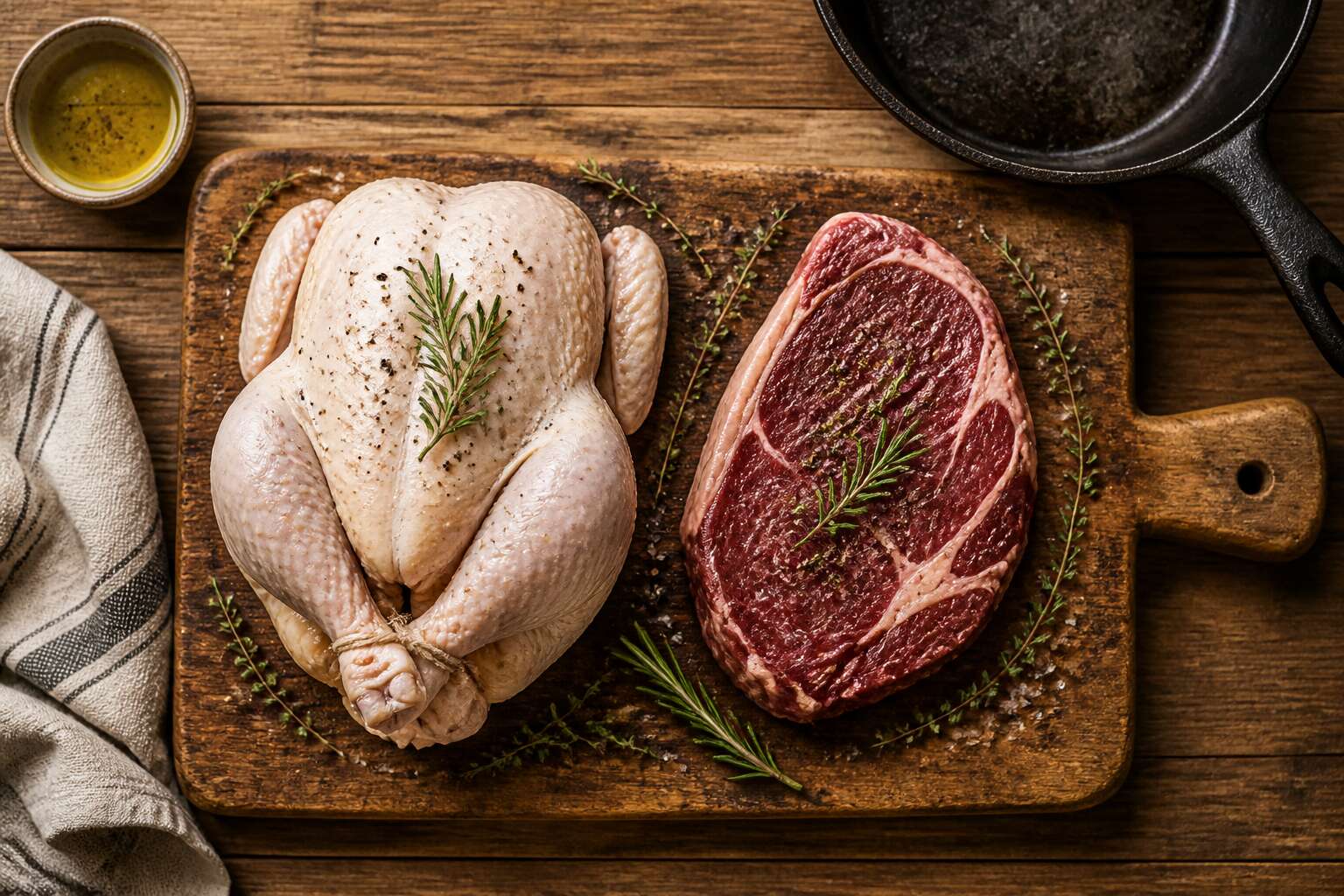
Nutritional Profiles at a Glance
Protein Quality and Amino Acid Composition
When South Africans weigh poultry vs meat, the protein story often tips the scale. Chicken breast delivers roughly 31 grams of protein per 100 grams, while lean beef offers about 26 grams. Yet the real distinction lives in amino acid composition, the building blocks our bodies demand for repair and growth.
Both sources provide complete proteins, containing all nine essential amino acids. However, their profiles diverge in meaningful ways. Beef carries higher histidine and methionine, compounds tied to tissue regeneration, while poultry edges ahead in tryptophan and threonine, which support serotonin production and liver function.
- Collagen content: meat contains more, contributing to joint health.
- Fat marbling: this reduces protein density per serving.
- Digestibility: poultry scores marginally higher in absorption rates.
Cooking methods alter these profiles, too. Gentle poaching preserves delicate amino acids, while high heat can denature certain chains. For athletes watching recovery, this subtle biochemical difference matters more than the kilogram price tag.
Fat Content and Types of Fats
Fat separates poultry vs meat more sharply than any other macro nutrient. A 100 gram ribeye carries 22 grams of fat. Skinless chicken breast holds barely 3 grams. Even the fattiest chicken cut, the thigh with skin, stays under 15 grams.
Quantity matters. So does composition! I have watched nutrition clients obsess over fat grams while ignoring fatty acid structure. Beef fat contains mostly palmitic and stearic acids. Poultry fat contains more oleic acid, the same monounsaturated compound found in olive oil. Grass fed beef adds conjugated linoleic acid, a compound absent from conventional chicken. This poultry vs meat difference explains why heart health guidelines often favour chicken.
- Beef: higher saturated fat concentration
- Chicken: more mono and polyunsaturated fat
- Skin removal cuts chicken fat by roughly half
Caloric Density and Energy Contribution
When you place a portion of chicken breast next to a braaied sirloin, the poultry vs meat caloric gap becomes obvious. A 100 gram serving of skinless chicken delivers around 165 calories. The same weight of lean beef sits near 200 calories, and a fattier cut climbs past 270. That shift affects daily energy budgets, especially for anyone tracking intake for weight management or athletic performance.
Energy contribution depends on how each protein source works within your body. Beef provides a denser fuel load due to its fibre structure. Chicken offers a lighter option, letting you eat a larger portion for the same caloric cost. The poultry vs meat comparison also extends to cooking style. Frying adds exterior oils, while grilling or baking preserves the original energy profile, giving you more control over what you consume.
Health Implications and Dietary Considerations
Cardiovascular Health and Cholesterol Levels
Cardiovascular disease remains South Africa’s leading natural cause of death, and the poultry vs meat decision shapes your cholesterol profile. White meat from chicken or turkey offers leaner options, yet the cut and cooking method matter more than the animal. Dark meat and skin introduce saturated fat that elevates LDL cholesterol, while processed meats like boerewors or biltong add sodium and preservatives that strain arterial health.
Dietary cholesterol in poultry and meat plays a smaller role than previously believed, but accompanying nutrients tip the balance. Consider these cardiovascular factors:
- Grilling or baking beats frying, which adds trans fats.
- Removing skin from poultry reduces cholesterol impact.
- Lean cuts of meat, such as sirloin, rival chicken breast.
Your body responds differently to each source! Monitoring blood lipid levels after meals provides personal insight. The poultry vs meat choice hinges on preparation and portion control rather than simple labels.
Cancer Risk and Processed Meats
The International Agency for Research on Cancer classifies processed meat as a Group 1 carcinogen, placing boerewors, polony, and biltong alongside tobacco smoke. Within the poultry vs meat debate, this processing layer changes everything I check on a label. Nitrates and nitrites generate N-nitroso compounds during digestion, agents directly linked to colorectal DNA damage.
Fresh chicken and unprocessed cuts bypass this pathway, but cured poultry reintroduces the same hazard.
- Nitrate-cured chicken polony shows mutagenic potential comparable to cured pork.
- Smoking and fermentation produce polycyclic aromatic hydrocarbons.
- Phosphate additives disrupt calcium signalling in intestinal cells.
The poultry vs meat distinction blurs when curing and smoking equalise risk across species. South African braai culture rarely separates fresh cuts from processed ones, yet the carcinogenic load of a smoked wing exceeds that of a raw breast considerably.
Weight Management and Body Composition
In the poultry vs meat debate, weight management hinges on more than arithmetic. Chicken breast offers a higher protein-to-energy ratio, amplifying satiety without burdening daily kilojoules. Red meat, particularly lean cuts, provides comparable fullness but demands stricter portion vigilance. The thermic effect of protein also favours poultry, since digesting it burns slightly more energy.
- Poultry typically yields a leaner profile per serving.
- Red meat offers higher iron and zinc density.
Consider your satiety signals. Some diners feel more satisfied after red meat due to its iron content. Others prefer poultry’s lighter profile. Individual response dictates success. A braai platter of skinless chicken thighs versus rib-eye often determines your body composition trajectory. For those seeking muscle retention while cutting, poultry supports nitrogen balance efficiently. Yet beef supplies creatine and zinc, aiding recovery and hormone function, a factor that complicates the poultry vs meat choice.
Satiety, Hormones, and Appetite Regulation
I have watched clients wrestle with the poultry vs meat question, and the real battleground is hormonal. Poultry protein triggers a brisk insulin response, quieting hunger quickly. Red meat, however, stimulates glucagon more steadily, which keeps appetite at bay for hours. That distinction shapes your entire day!
Consider ghrelin, the hunger hormone. Poultry’s high leucine content actively suppresses it, but red meat’s satiating effect relies on fat and zinc. My own experience? A lean beef patty holds me longer than a chicken breast, even at equal calories. The choice therefore depends on which hormonal pathway your body trusts more.
- Poultry lowers ghrelin rapidly
- Red meat sustains fullness via zinc and fat
Allergies, Intolerances, and Dietary Restrictions
Nearly one in five South Africans report some form of food sensitivity, yet the poultry vs meat debate rarely considers how our bodies react. Chicken allergies can be triggered by proteins in the flesh or eggs, and many commercially raised birds carry traces of antibiotics or saline injections that irritate hypersensitive guts. Red meat presents its own obstacles, especially alpha-gal syndrome, a tick borne allergy that renders beef and lamb dangerous. I have seen clients in Limpopo who cannot eat a single chop without hives.
Dietary restrictions complicate matters further. Halal preparation, kosher slaughter, and allergen labelling all carry weight here.
- Chicken may be cooked with broth containing hidden allergens.
- Beef can be aged, raising histamine loads that trigger migraines.
For many households, the poultry vs meat choice is not about preference but about what the body will tolerate.
Environmental Impact and Ethical Choices
Carbon Footprint and Greenhouse Gas Emissions
I have stood at the edge of a Free State farm, and the difference hits you before the smell does! The carbon footprint of poultry vs meat reveals a stark truth: cattle belch methane, while chickens emit mostly carbon dioxide from respiration. Methane traps heat far more effectively, making beef’s impact heavier.
Ethical choices also hinge on scale. A single steer requires hectares of grazing land, whereas a broiler house stacks thousands of birds in a fraction of that space. Water usage and feed conversion matter just as much as emissions in this debate.
- Beef: high enteric fermentation, high water demand
- Chicken: efficient feed conversion, lower land pressure
These factors push many South Africans toward poultry for environmental reasons, though the full story includes manure management and transport emissions.
Land Use, Water Consumption, and Deforestation
A single free-range broiler needs about three and a half square meters, while one beef steer can claim an entire smallholding. That difference defines the land use debate in the poultry vs meat conversation! Cattle ranching drives deforestation in parts of Southern Africa, pushing back woodlands for pasture. Broiler operations, although intense, pack birds efficiently and leave more ground untouched.
Water demands sharpen the contrast. Producing a kilogram of chicken requires roughly 4,300 litres, but beef can exceed 15,000 litres.
- Beef: high water demand per kilogram
- Chicken: lower water intensity per kilogram
- Deforestation risk: higher for cattle grazing
These trade-offs force a practical choice. When you weigh poultry vs meat for environmental reasons, chicken usually carries the lighter burden, but the farming method holds its own weight.
Animal Welfare and Farming Practices
When the poultry vs meat conversation turns to ethics, the contrast becomes less about nutrition and more about sentience. In South Africa, broiler houses often hold tens of thousands of birds, yet the birds themselves have short, intense lives. A free-range system grants space, but it also exposes birds to predation and disease. Cattle, by comparison, develop individual bonds and show measurable stress responses when separated. The scale of suffering differs, not the nature of it.
Farming practices shape both scenarios. Battery cages have largely disappeared from local operations, but crowding remains the norm. For beef, pasture rearing dominates the Northern Cape and Free State, where herds move slowly across veld. That sounds idyllic, yet drought forces supplementary feeding and, at times, early slaughter.
- Chicken: faster turnaround, lower emotional complexity per animal
- Beef: longer lifespan, stronger welfare scrutiny per individual
I find the poultry vs meat dilemma is really a question of volume versus visibility. A single steer suffers visibly; a thousand broilers suffer invisibly. Neither system is blameless, and the consumer’s ethical comfort often depends on how far they look past the packaging.
Sustainability Certifications and Labels
Environmental impact of poultry vs meat is a confusing array of labels. A “free-range” sticker does not tell you how many litres of borehole water that chicken drank, nor does “grass-fed” reveal the diesel burned to truck cattle to a feedlot. Sustainability certifications in South Africa are a mix. The SA Poultry Association offers an assurance mark, while beef has the Meat Board’s protocols. But these focus on disease control, not ecological footprints. A certified chicken and an uncertified one can have identical carbon impact. Ethical consumers treat badges as conclusive proof. They are not. Consider what they promise:
1. Traceability, not sustainability.
2. Animal husbandry standards, not water usage.
3. Biosecurity, not soil health.
The choice comes down to visibility. A farmer who lets you inspect the dam and the feedlot might be worth more than any certification. In poultry vs meat, the environment stays off the label.
Role in Global Food Security
In South Africa, drought reshapes farmland and the environmental impact of poultry vs meat becomes a matter of survival. A kilogram of beef drinks roughly 15,000 litres of water. A kilogram of chicken asks for far less. The ethical choice is a food security choice, not a separate luxury.
Global food security rests on how efficiently we turn scarce inputs into protein. Poultry vs meat decides yield per hectare, feed conversion, and time to harvest. Broilers reach slaughter weight in six weeks. Cattle take years. For a dry country, that arithmetic carries weight.
- Chicken returns protein faster per unit of resource.
- Beef consumes more land and water per calorie.
Ethical choices now extend past animal welfare into stewardship of water, feed, and energy. Households watch rising prices and make quiet calculations. The choice is the quiet arithmetic of feeding a nation.
Culinary Applications and Preparation Techniques
Flavor Profiles and Texture Differences
Standing over a braai fire, the difference between poultry vs meat becomes obvious before the first bite. Chicken thighs absorb marinades within thirty minutes, while beef brisket demands an overnight soak and slow smoky hours to break down stubborn collagen. Texture differs clearly: poultry gives tender, fine-grained flesh that dries out fast, while meat offers a denser bite with marbled fat that renders slowly over heat.
Preparation techniques diverge sharply here, and I have burned enough chicken to respect the difference. Poultry needs high heat for crisp skin, cooked to 74°C and rested briefly. Meat rewards low and slow cooking, followed by a longer rest so juices redistribute. Flavour profiles differ just as much. Poultry tastes mild and absorbent, picking up subtle herb rubs and citrus. Meat carries a deeper, mineral savouriness that pairs with punchy sauces. The cooking method shapes that final flavour and mouthfeel every time.
Optimal Cooking Methods for Tenderness and Juiciness
Getting the best out of poultry vs meat requires different heat protocols. For poultry, high heat and short cooking time preserve moisture. Searing skin side down first, then finishing at 74°C keeps the breast juicy. For meat, low and slow breaks down sinew and collagen. A lamb shoulder needs hours at 135°C before yielding.
- For poultry: high heat, quick sear, and a rest of only five minutes.
- For meat: low heat, prolonged cooking, and a rest of at least fifteen minutes.
Using a thermometer beats guesswork. Carryover cooking raises internal temperature after you pull the item off the heat. For meat, that carryover can be 5°C, so removing it earlier works well. For poultry, lean flesh can’t afford carryover, so targeting the exact temperature helps. These techniques make tenderness and juiciness reliable, every time.
Recipe Substitutions and Adaptations
Chicken braai spice does not belong on a steak, and that is a hill worth dying on. Yet recipe substitutions between poultry vs meat are more about technique than flavour. Swapping chicken thighs for beef chuck in a stew requires a longer simmer. A lean fillet swapped for a chicken breast needs a watchful eye and a quick pan. The proteins behave differently, so the cook must adapt.
When the recipe calls for a whole chicken, a deboned lamb leg can work, but the cook time changes vastly. The same goes for mince. Lamb mince in a bobotie is delicious, but it renders more fat than chicken mince. Adjust the dish accordingly.
– Poultry substitutes best in quick, high heat dishes.
– Meat substitutes shine in slow, moist cooking.
– Lean cuts need extra fat or moisture.
– Dark meat poultry can handle longer cooking.
For a Sunday potjie, using chicken pieces instead of beef changes the liquid level. Chicken releases water, beef does not. The braising liquid must be reduced. Sausage, such as boerewors, can replace chicken in a one pot meal, but the casing needs a sear first to hold shape. This is the subtle art of swapping one protein for another.
Cost per Serving and Market Price Trends
In South Africa, the poultry vs meat debate often comes down to rand and cents. Chicken leg quarters hover around R45 per kilogram while beef chuck climbs past R130. That gap makes the family braai feel like a financial decision, not a social one. The culinary applications diverge as sharply as the pricing.
Poultry responds to quick heat. A spatchcocked bird over coals crisps the skin in twenty minutes. Meat rewards patience. A lamb shoulder needs hours to surrender its collagen, delivering a depth that chicken cannot match. These techniques are not interchangeable.
- Chicken: brined, grilled, or roasted; forgiving on time, strict on internal temperature.
- Beef: braised or slow cooked; forgiving on temperature, strict on time.
Market price trends show chicken tracking global feed costs, while beef prices follow drought cycles in the Karoo. When beef spikes, poultry consumption rises. The poultry vs meat cost gap narrows only when you factor in the fuel and hours required for slow cooking. A R70 chicken feeds four. A R200 lamb leg feeds six, but demands a full afternoon.
Food Safety, Handling, and Storage Practices
In the kitchen, the poultry vs meat decision shapes how you manage time and temperature. Chicken demands precision. Undercook it, and you face salmonella risk. Overcook it, and the breast dries out. Trust me, a probe thermometer is non-negotiable. Beef, by contrast, tolerates more error. A steak can rest between medium rare and medium well, and a slow-braised short rib stays edible even if you lose track of time.
Storage practices diverge as well. Raw chicken should sit on the bottom shelf, sealed, to avoid drips contaminating your greens. Beef benefits from a dry rest in the fridge, unwrapped, to develop a crust before cooking.
- Keep chicken at or below 4°C.
- Use separate cutting boards for raw meat and poultry.
- Cook chicken to 74°C internal; ground beef to 71°C.
These habits prevent cross-contamination, a common source of kitchen accidents.
Economic and Budgetary Considerations
Price Comparison Across Cuts and Products
In South African butchery aisles, the economic tale of poultry vs meat unfolds with stark clarity. A whole frozen chicken often costs less per kilogram than a single beef steak, making it the default protein for many households.
Consider the price hierarchy across cuts. The gap between poultry vs meat narrows at the premium end, but everyday staples tell a different story.
- Frozen chicken portions: roughly R45 to R60 per kilogram
- Beef mince: R90 to R120 per kilogram
- Lamb chops: R150 to R200 per kilogram
These figures shift with market trends, yet the pattern remains steady. Poultry stretches further when feeding a family, while premium meat cuts demand a higher outlay for special occasions.
Production Efficiency and Yield Rates
If a chicken could do maths, it would laugh at a cow! The production efficiency of poultry vs meat starts with feed conversion. A broiler turns roughly 1.7 kilograms of feed into a kilogram of live weight, while a beef animal often requires six or more. That biological edge converts directly into your rands.
- Broiler chickens reach market weight in about six weeks.
- Beef cattle can take eighteen months or longer to finish.
This shorter cycle means lower carrying costs for the producer, and I see the result in my local butchery, where poultry vs meat pricing remains lopsided. Your money covers the flesh and the months of grazing, water, and medicine that went into the steak. Poultry turns over rapidly, keeping the shelf price sticky and low.
Impact of Supply Chains and Global Markets
When the rand weakens, the poultry vs meat calculus shifts overnight. South Africa imports a substantial share of its broiler meat, so any disruption in Brazilian or European supply chains directly hits your butchery’s price tags. A port closure in Durban or a maize shortage in the Free State sends costs spiraling through the entire protein aisle.
Local beef producers face their own exposure. Feed grains track global markets, and a dry spell on the veld forces early herd culling, flooding the market with meat that later becomes scarce. The household budget, then, becomes a mirror of international logistics.
- Exchange rate volatility changes the landed price of imported poultry within days.
- Shipping container availability alters freight costs for frozen cuts.
- Grain futures, from Chicago to Johannesburg, dictate what cattle eat and what you pay.
These factors make poultry vs meat a living economic equation, not a static choice. Short-term bargains appear when suppliers overstock, but producers adjust quickly. Your rands follow the cargo ships and the silos.
Strategies for Cost-Effective Meal Planning
Planning meals around the weekly specials board is one way to keep the poultry vs meat decision from wrecking your budget. I check the local butcher’s flyer before I plan a single dinner. Frozen chicken portions often underprice fresh beef by a significant margin, but that gap narrows when you factor in waste and preparation time.
Buying a whole bird and breaking it down yourself gives you two breasts, two thighs, two drumsticks, and a carcass for stock. Compare per-kilogram prices of bone-in cuts against deboned options. Sometimes the extra cost for convenience is worth it, sometimes it is not.
- Chicken livers and beef chuck respond well to slow cooking.
- Leftover roasted chicken becomes sandwiches, soup, or a pasta topping.
- A pressure cooker cuts energy costs for tough cuts.
Bulk cooking on a Sunday turns one large batch of curry or stew into four or five dinners. That spreads the cost of the poultry vs meat choice across multiple meals for the week.



0 Comments